The Clocks Went Back. Every Fix I Bought Was Aimed at the Road. Not One Was for My Eyes.
$140 in night-driving glasses and a drawer to keep them in. At 64 I finally read one fact about the eye itself that nobody had ever told me. Here's what I do now.
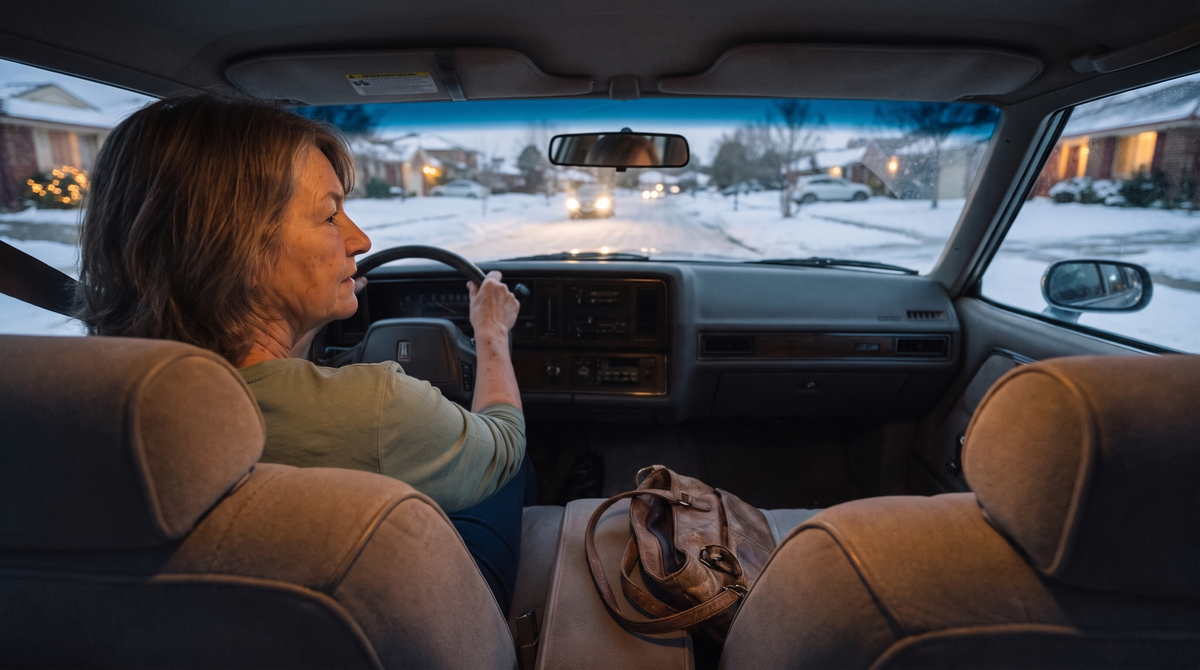
The clocks went back. Now every drive home is a night drive.
If that sentence gives you a knot in your stomach, this is for you. I'm 64, and I spent a whole year fixing the wrong thing.
In July I can go to supper at my daughter Karen's, help with the dishes, and be home with light to spare. In November the sun is gone before five. Same drive, same road, same supper. Except now it's dark both ways.
So the excuses started. I was "tired." I had "a headache." I'd come Saturday instead, for lunch. I told my book club I'd be back in the spring. I quit Thursday night choir practice after nineteen years.
Nobody made a fuss. That's the strange part. You get so good at arranging your life around the dark that everyone stops noticing. Even you.
Look where every fix I bought was pointed
I tried to fix it quietly, where nobody would see.
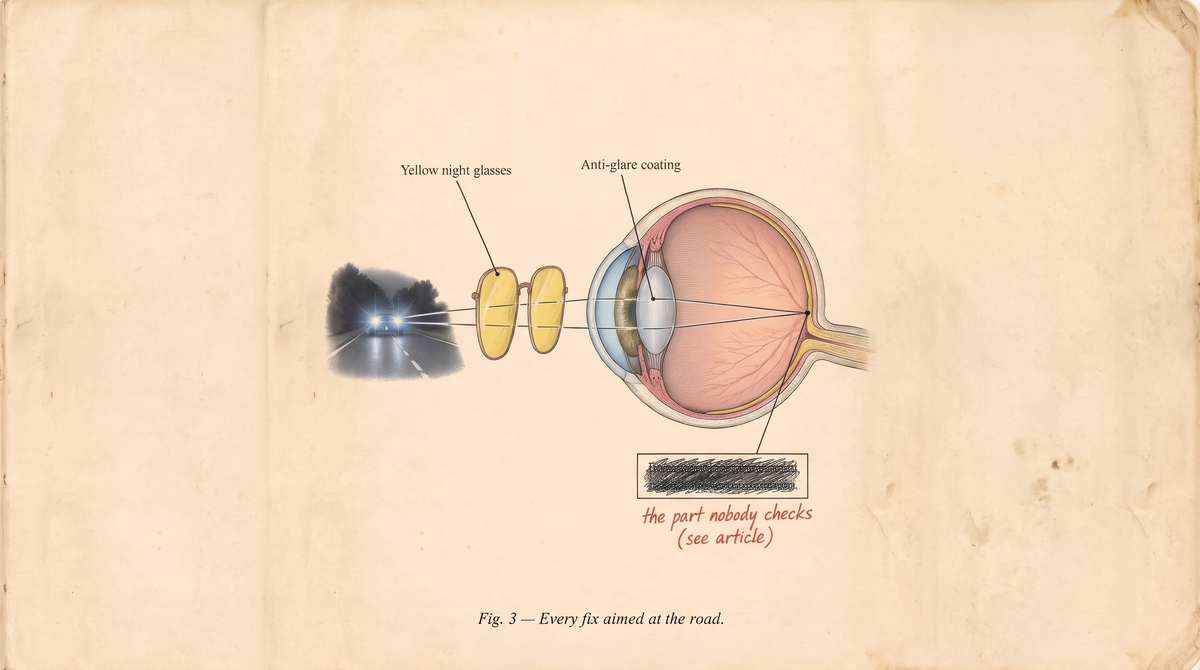
The yellow night-driving glasses. $27.97 with shipping. The headlights turned yellow. That's all that changed.
A polarized clip-on pair, to go over my regular glasses. Now everything was darker, not just the headlights. It felt like wearing sunglasses at night.
The expensive wraparounds. The small print on the side of the box said NOT FOR NIGHT DRIVING. I am not making that up.
Anti-glare coating on my old prescription lenses. It helped with reflections on the dashboard. It did nothing when a truck came over the hill.
The little things. Cleaning the windshield. Dimming the dash. Sticking to roads I knew by heart.
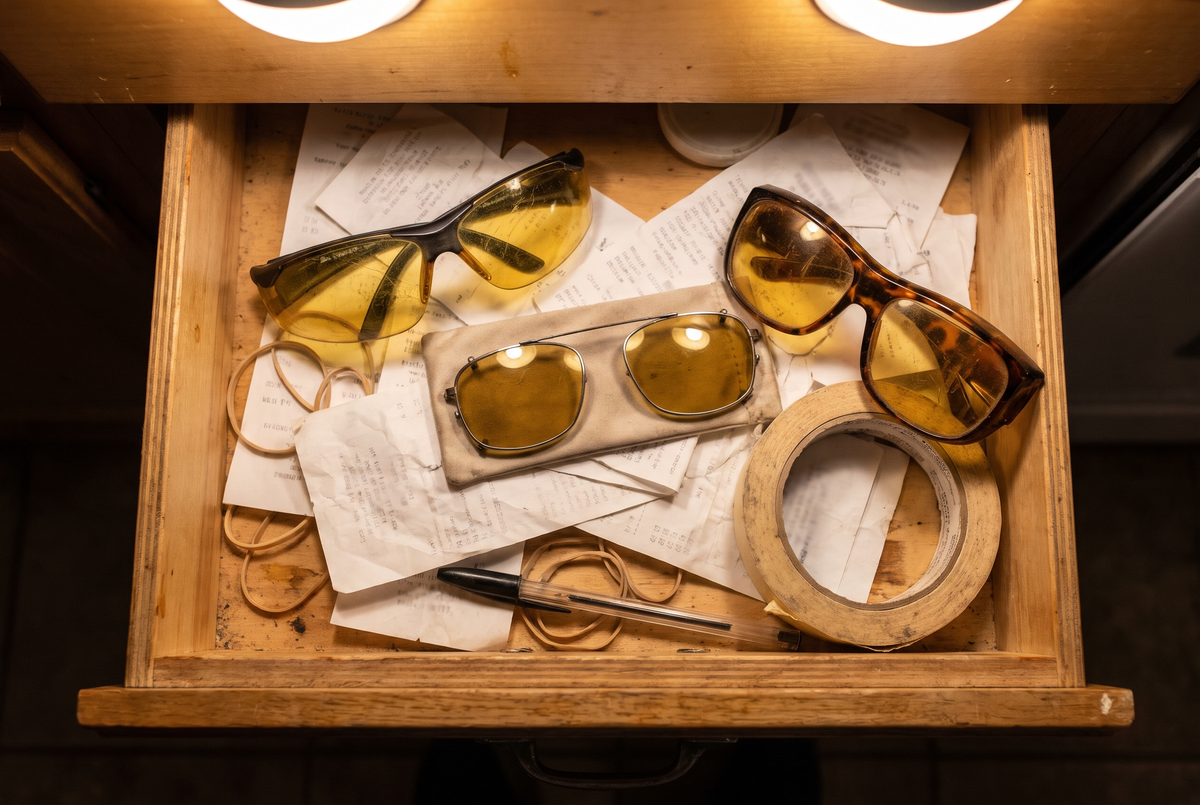
About $140, three pairs of glasses in a kitchen drawer, and a list of excuses that got longer every week.
Every single one of them sat in front of my eyes and worked on the light coming in.
Not one of them had anything to do with the eyes doing the seeing.
I'd never heard a word about the part behind the glass. Then I read one fact about the eye itself that I still can't believe nobody mentions.
What I learned about the eye itself
Here's what I read. I had never heard a word of it in 64 years.
One, after a bright light your eyes take a few seconds to come back, and that gets slower once you're past about 55. Doctors have actually timed it. That was my few seconds of nothing every time a pickup came the other way.
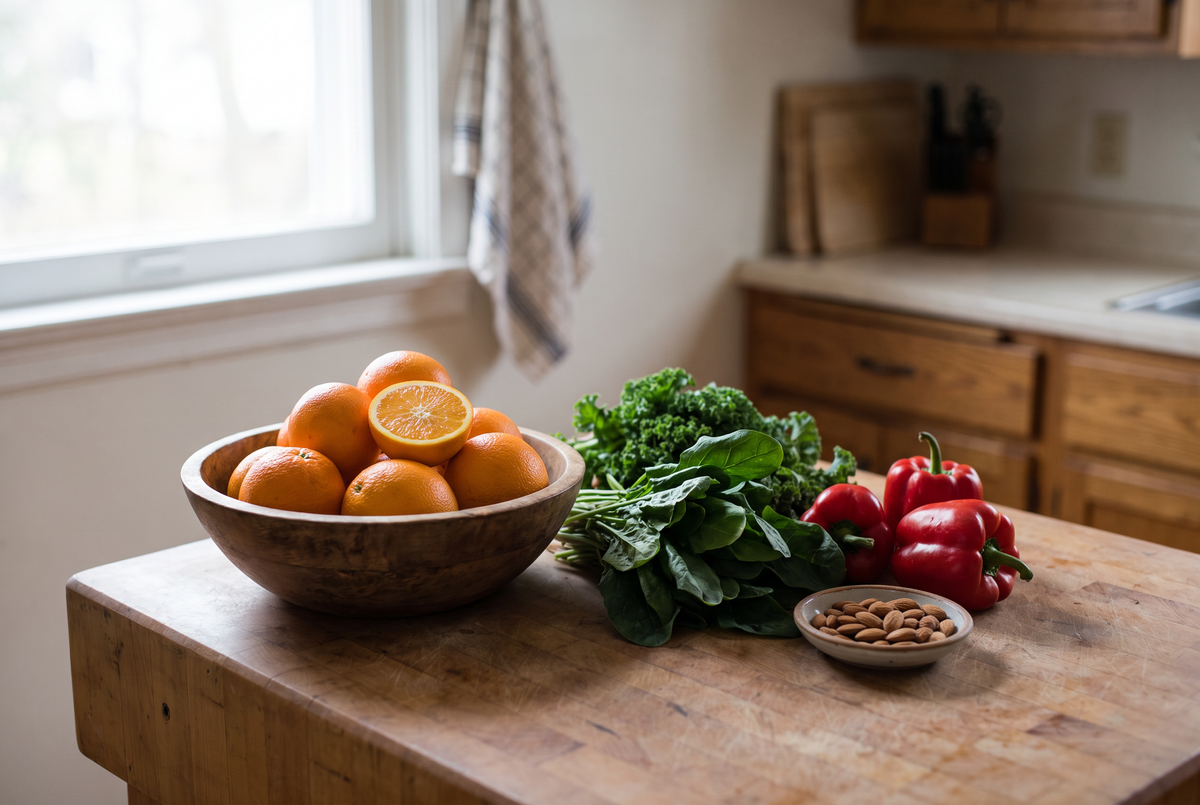
Two, your eyes need things from food to work right, like lutein from greens and vitamin C, and your body can't make lutein on its own. Since my husband passed it's mostly soup and toast. Not a lot of greens.
I also read your eyes hold a lot of vitamin C and zinc. I'd never once thought about what my eyes might need.
Nobody at the glasses counter ever mentioned any of that.
Lutein is the yellow stuff in leafy greens, corn and eggs, and it sits right in the middle of your eye.
None of this is a secret. It's sitting in the research journals. But in all those night-driving ads, not one ever said a word about the eye.
Here's what I took from it. My eyes use these nutrients every single day. My body can't make them. They only come from what I eat and take.
I'd spent $140 on things to put in front of my eyes. I hadn't spent a dime on the eyes themselves.
How I finally got there
I'd love to tell you I went looking for that on my own. I didn't. It took a nine-year-old.
My granddaughter asked me why I don't drive to her house after dark anymore.
I told her the car was in the shop.
It wasn't. It was sitting in my driveway, forty feet from where we were standing, with a full tank of gas.
Emma is nine. She was standing in my kitchen in her yellow cardigan, holding a drawing she'd made me, and she asked it the way children ask everything. Straight out.
"Grandma, how come you don't come to Wednesday supper anymore?"
"The car's in the shop, sweetheart."
She thought about that for a second. Then she said, "Again?"
That one word. It meant she'd been keeping track. It meant I had told her the same thing before, and she had noticed, and she was too polite to say so.
I have never lied to that child. Not about her goldfish. Not about her grandpa Dale, when she was five and asked where he went. I told her the truth both times, as gently as I knew how.
But I lied to her about a car. Because the truth was something I couldn't say out loud yet. Not even to myself.
It started with the drive home
It was my sister Joan's birthday last October. Six of us at the Italian place out on Route 9. Lots of laughing.
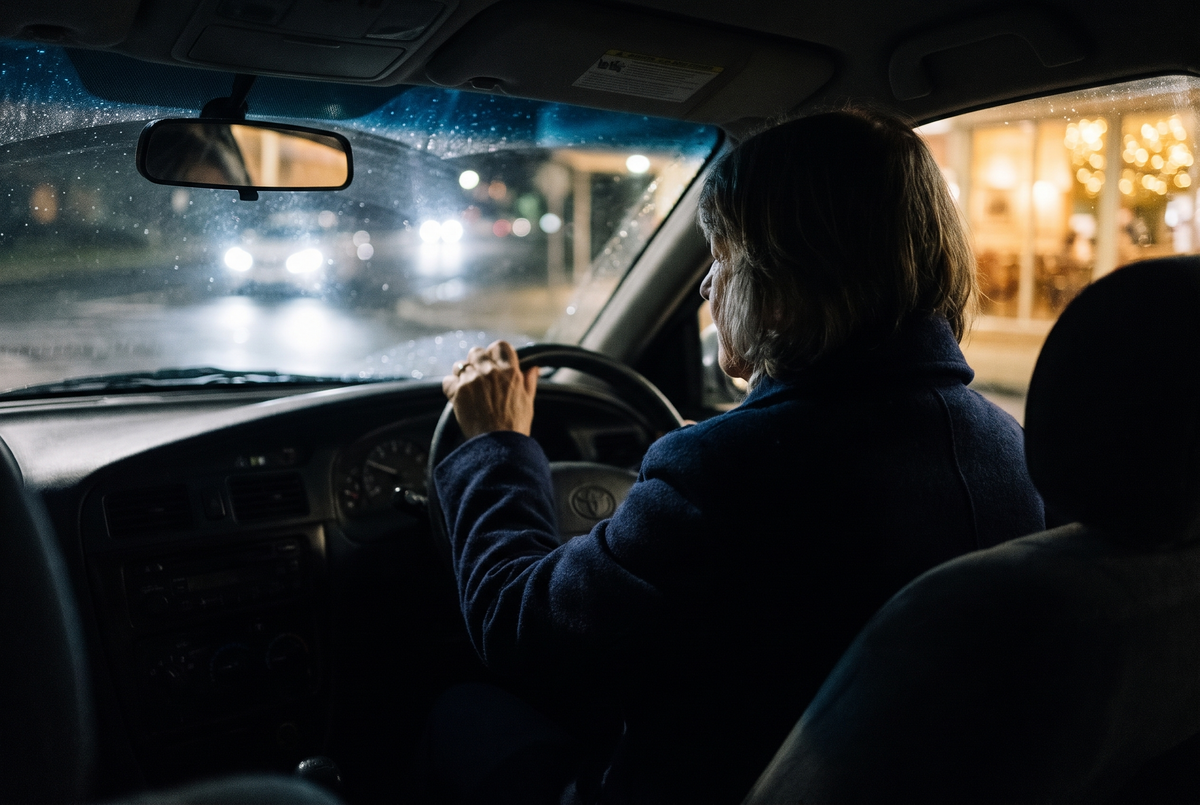
When it was over, I walked out to my car, got in, put the key in, and didn't turn it.
I sat in that restaurant parking lot for ten minutes, dreading the drive home.
Fourteen miles. Two lanes most of the way. No streetlights after the gas station. And every few seconds, a pair of those new headlights coming the other way. The bright blue-white ones that sit right at eye level on the big pickups.
I knew exactly what it would be like, because it had been like that for a year. Gripping the wheel. Steering toward where I thought the lane was. Getting home and sitting in the garage with my heart pounding.
Joan tapped on my window. "You okay, Sue?"
"Just checking my phone," I said.
That was a lie too. I was getting good at them.
Why I couldn't tell anyone
My husband Dale did most of the night driving for 38 years. When he passed, it was just me and the Buick.
That car isn't really a car. It's how I get to church, to Joan's, to the grandkids. It's the difference between living my own life and waiting for somebody to have time for me.
And I'd seen what happens when that goes.
My friend Marilyn from church had a little fender-bender pulling out of the pharmacy at dusk, two winters ago. Nobody was hurt. Within a month her son had her keys. "It's for your own good, Mom."
Maybe it was. I'm not saying it wasn't. But I watched what came after.
Marilyn sees her grandkids when someone has time to drive her. She gets to church when someone remembers to pick her up. She told me once, over coffee, "I didn't lose the car, Susan. I lost the say."
The day someone takes your keys is the day someone else decides when you see your grandkids.
I thought about that every time I drove at night. And I made a decision I'm not proud of. If nobody knew, nobody could take them.
So I hid it. From Karen. From Joan. From my own doctor, honestly. And from Emma.
The Saturday Emma found the car
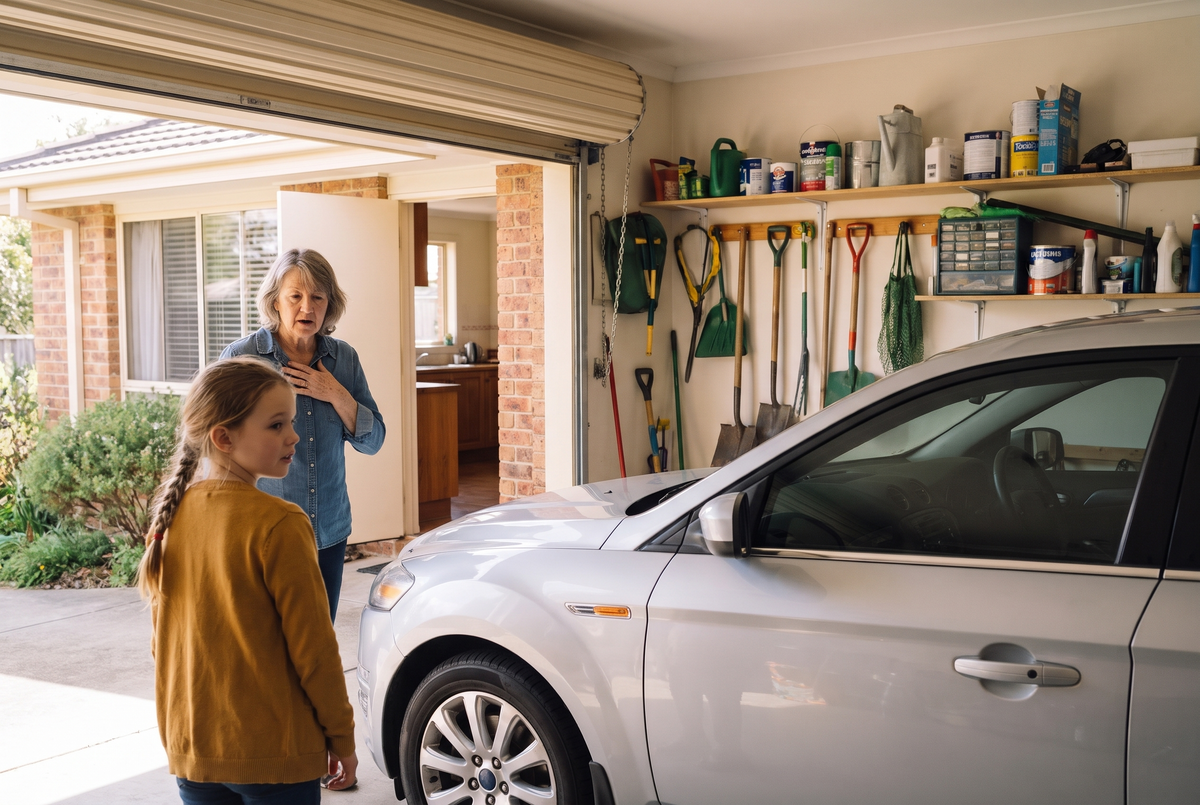
Two weeks after "Again?", Karen dropped Emma off for a Saturday at my house. We were baking cookies, and she ran out to the garage for the step stool.
She came back in slowly.
"Grandma. The car's here."
I stood in the doorway with flour on my hands.
"You said it was in the shop."
I had nothing. No headache. No checking my phone. Just a nine-year-old looking at me the way I used to look at her mother when she swore she'd done her homework.
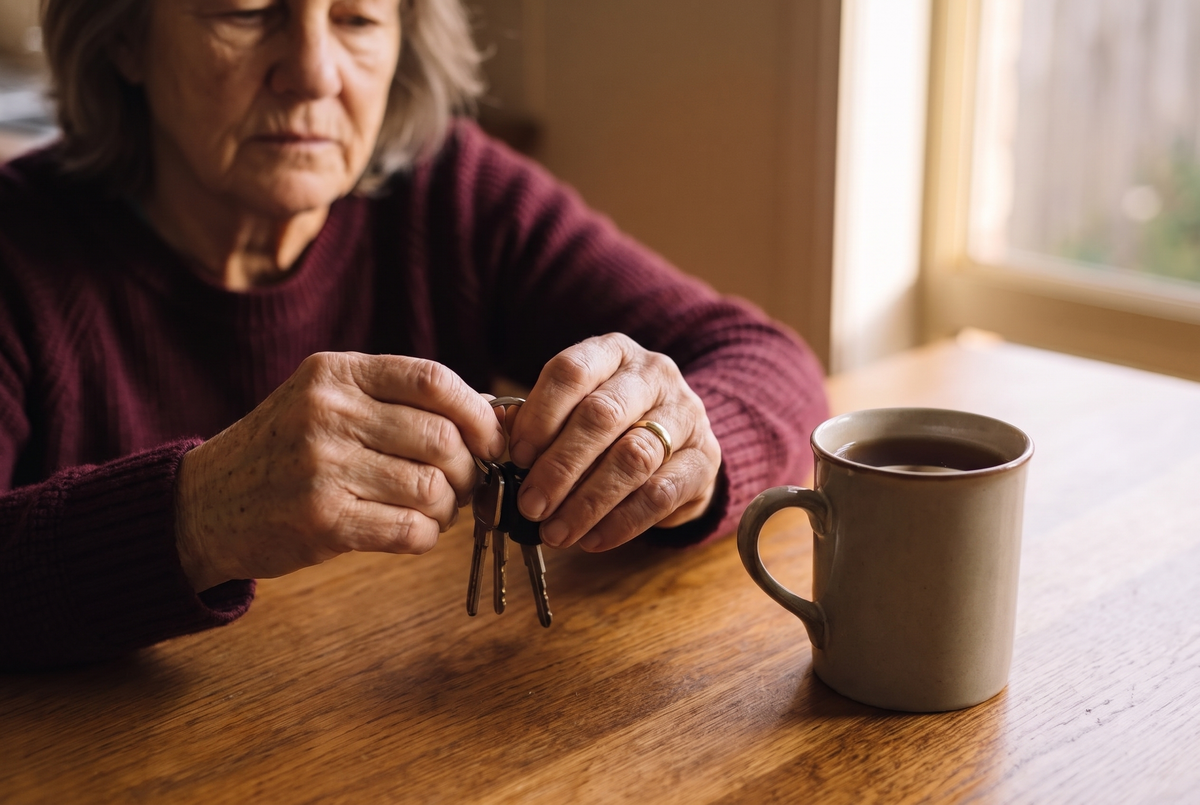
That night, after Karen picked her up, I sat at the kitchen table for a long time. And I finally saw what I'd been doing.
For a whole year, every single thing I'd done was about hiding the problem. The excuses hid it from my family. The lies hid it from Emma. Even the tinted glasses were a kind of hiding. Something to put in front of my eyes so I wouldn't have to look at what was going on behind them.
I hadn't had a proper eye exam in almost three years. I was so scared of what someone might say that I'd made sure nobody, including me, could say anything at all.
All that lying wasn't protecting Emma. It was protecting the fear.
A different question
So I stopped asking, "What can I put in front of my eyes?"
And I asked, "What about the eyes themselves?"
On Monday morning I called and booked the eye exam I'd been avoiding for three years. The first opening was five weeks out. I took it.
Five weeks felt like a long time to keep making excuses. Glasses are the part in front of the eye. So that night I started on the part I could do something about right away: the part behind the glass.
What I take now
My sister Joan found Stay Able Vision Support. It's two capsules you take with breakfast. Lutein, some vitamins, and bilberry, which Joan said is the one people swear by for driving at night. What I liked is it wasn't another pair of glasses making everything darker.
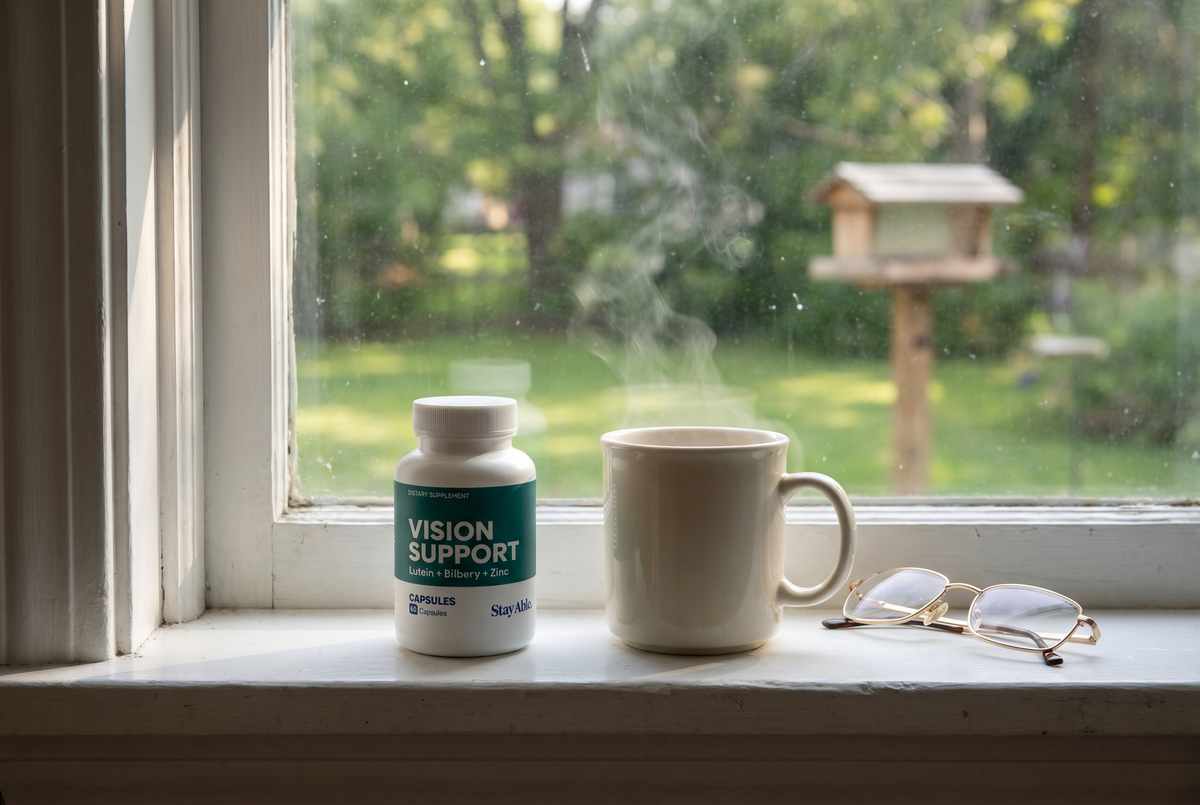
By the end of January it was a different drive. A truck would come over the rise and I'd see the road again almost right away. No more few seconds of nothing. Honestly, it's been a game changer. Joan takes it too and says the same. It doesn’t replace an eye exam or new glasses. It sits next to those things as a simple daily habit for the eyes doing the seeing.
What it is NOT
It won’t replace your eye doctor or your glasses. It won’t decide whether you should keep driving — that’s still between you and your doctor. And it isn’t instant; nutrients build with daily use.
What it is is a focused daily formula that supports the eyes with the nutrients they use every day. Many customers report clearer comfort with night driving and less eye strain once they’ve taken it consistently. If it isn’t right for you, the 100-day guarantee covers you.
When the appointment came around
Five weeks later I sat in the chair. "Isn't this just my glasses?" was the first thing I asked. Honestly? Partly, yes.
The doctor said my eyes were healthy for my age and my prescription had barely changed. So it was never my glasses. I'd still tell anyone to book that appointment.
My no-more-hiding checklist
The old me bought gadgets and made excuses. The new me has a checklist. Most of it is free.
1. An eye exam every year, or as often as your doctor says. Not "when I get around to it."
2. Windshield cleaned inside and out, every week in winter. You'd be amazed at the film on the inside.
3. Headlights checked. On older cars the plastic covers go cloudy. A restoration kit at the auto parts store runs about $20.
4. Dash lights turned down low.
5. Eyes to the white line. When a car comes toward you, look down and to the right, at the white line on the edge of the road, until it passes. A long-haul trucker shared that one online years ago.
6. Clear lenses only. The yellow glasses went in the donation box.
7. Two capsules with breakfast.
The truth, finally
The hardest part wasn't the eye exam. It was the phone call to Karen.
I told her everything. The parking lot. The excuses. The car that was never in the shop. I told her I'd been scared that if I said one word, she'd take my keys, the way Marilyn's son took hers.
There was a long quiet on the line. Then she said, "Mom. I'd rather know. I can't help with what you hide from me."
She didn't take my keys. We made a deal instead: I'd tell her straight if the night drives got bad again. They haven't. I drive myself to Wednesday supper, after dark, with a clean windshield and my eyes on the white line.
It's still my say. It's just my say with the truth on the table.
The next Saturday I sat on the porch steps with Emma and told her I was sorry.
"So the car was never in the shop?"
"No, sweetheart. Grandma was scared, and I fibbed. That wasn't fair to you."
She leaned into me and thought about it. "Can you still come Wednesdays?"
"Every Wednesday. I'll drive myself."
"Okay," she said. "Good."

The exam and one honest phone call mattered. But the capsules are what changed the drive, and they're the one thing I'd keep.
What the capsule is, is my part of looking after the eyes I've got. Every morning, out in the open, with nothing left to hide.
Who this is for
It's not a quick fix. It's a daily habit you give a few weeks.
What it costs
I spent about $140 on three pairs of glasses that now live in a donation box.
Stay Able Vision Support is $37.99 for a one-month bottle. If you'd rather not run out, Subscribe & Save brings it to $29.99 a month (that's the subscription price; skip or cancel anytime). A 3-month supply is $99.99, and 6 months is $179.99.
It comes with a 100-day money-back guarantee. If it's not for you, email us within 100 days and we'll refund you.
You might be wondering
Isn't this just my glasses?
It might be, partly. Mine was. That's why I booked the exam too. Glasses work in front of the eye. This is about nutrients the eye itself uses. They're different jobs, and one doesn't replace the other.
Will this help me see better at night?
Lots of customers tell us headlights bother them less and their eyes feel less tired once they've taken it consistently. Results vary, and it doesn't replace your eye doctor.
Will this keep me driving?
No. Nothing in a bottle can promise that. Whether and when you drive at night is for you, your eye doctor and your family to decide, honestly.
I take other medications. Is it okay for me?
Show the label to your pharmacist or doctor before you start. Ask especially if you already take a multivitamin or another eye vitamin, so you don't double up on zinc.
Can't I just eat better?
You should! Leafy greens and colorful fruit are good for every part of you. This is a simple daily backup for people who know their plate isn't perfect every day.
What if it's not for me?
It comes with a 100-day money-back guarantee. If it's not for you, email us within 100 days and we'll refund you.
Two choices
You’ve used the car as an excuse. You’ve sat in the parking lot dreading the drive home. The clocks going back make every evening feel harder.
You can keep doing that. Or you can book the eye exam, tell one person the truth, and start giving your eyes the daily nutrients a lot of people say help with the glare, the strain, and the night drives. Two capsules with breakfast. 100 days to decide.
P.S. Book the eye exam this week too. Mine was five weeks out, which is exactly why I didn't wait to start on the rest.
P.P.S. If there's a grandchild who's heard "the car's in the shop" one time too many, call their mom or dad this week. It's a hard call. It's a lot easier than being found out in the garage.
Sources: vitamin C concentration in the eye and vitamin C regenerating vitamin E, Nutrients 2020; ocular zinc, Progress in Retinal and Eye Research review.
These statements have not been evaluated by the Food and Drug Administration. This product is not intended to diagnose, treat, cure, or prevent any disease. Individual experiences vary. Dramatization: Susan Miller is a composite character, and her story is a dramatization.