Melatonin Got Me to Sleep. Then It Took My Whole Morning.
I traded sleepless nights for foggy days and thought that was the best deal going. It wasn't. Here's what I take now, and why I finally wake up feeling like myself.

Tired of waking up foggy?
I was.
For about a year, I slept eight hours and woke up feeling like I'd had four.
Heavy head. Slow legs. That underwater feeling.
I'd pour a cup of coffee and stand at the counter trying to remember what I'd walked into the kitchen for.
The pills were working. That was the crazy part.
They got me to sleep every night. It was the woman who woke up that I didn't recognize.
How I got there
A few bad nights turned into a few bad months. So I did what everybody does. I went to the drugstore.
First, the melatonin gummies. Ten milligrams. They put me under. They also gave me dreams so strange I woke up tired from them. And the next morning I was grumpy and thick-headed until about eleven.
I cut them in half. Same fog, just less sleep.
Then the PM pills. Those knocked me flat. Mouth like cotton. Brain like oatmeal.
One morning I drove my grandson to school and sailed right past the turn. A turn I've made a few hundred times.
He said, "Grandma, you missed it."
I laughed it off. I did not feel like laughing.
The lie I was telling
When my daughter asked how I was sleeping, I said, "Much better!"
And that was true. I was asleep.
I just wasn't there the next day.
I quit my Tuesday morning walking group because I couldn't get going before ten. I told them my knee was acting up.
It wasn't my knee.
So that was my choice. Lie awake at night, or sleepwalk through the day. Pick one. I was tired of picking.
What the label doesn't tell you
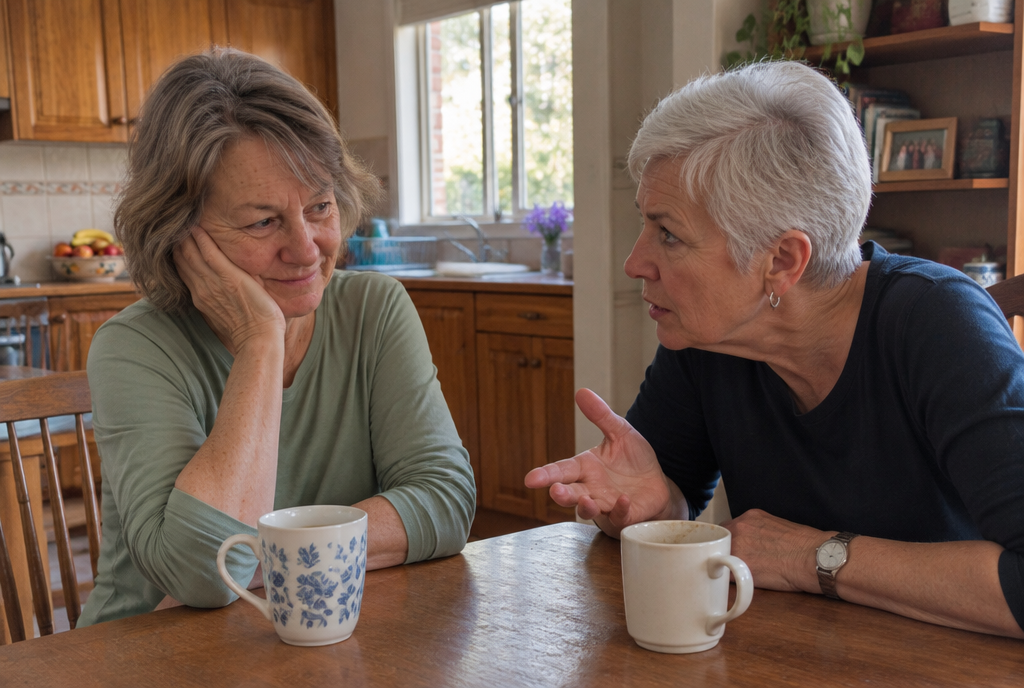
What finally turned it around was my friend Barb. She's a retired nurse and she doesn't sugarcoat.
I told her about the missed turn. She put her coffee down.
"Susan. What are you taking?"
I told her. She shook her head.
Here's what she told me. I checked every bit of it afterward.
About the PM pills. The sleepy ingredient in most of them is an old allergy drug. The American Geriatrics Society keeps a list of medicines that people over 65 are better off avoiding, and that ingredient is on it.
Why? Our bodies clear it more slowly. In one study it hung around about nine hours in younger adults and over thirteen in people our age.
Thirteen hours. Take it at 10pm and it's still on board at 11 the next morning.
No wonder I missed the turn.
About the gummies. Melatonin isn't a mineral or a vitamin. It's a hormone. And when researchers tested what's really inside melatonin products, some had far less than the label said and some had more than four times as much.
So I never really knew what I was taking.
Barb said, "Don't feel foolish. Nobody tells you this. They just sell you the box."
"So what do YOU take?"
That's what I asked her.
"Magnesium. The glycinate kind. It's not a sleeping pill. It doesn't knock you out. It just helps your body do what it's trying to do anyway."
A sleeping pill is like somebody throwing a blanket over your head. You're out, but you didn't get there on your own, and you wake up tangled in it.
Magnesium is more like turning the lights down. It's the mineral your nerves and muscles use to let go. Your body does the rest by itself.
And there's a reason it matters more at our age. The National Institutes of Health says that as we get older we eat less magnesium, absorb less of it, and lose more of it. Nearly half of American adults don't get enough from food to begin with.
No hormone. No allergy drug. Just a mineral I was probably short on.
The one I ended up with
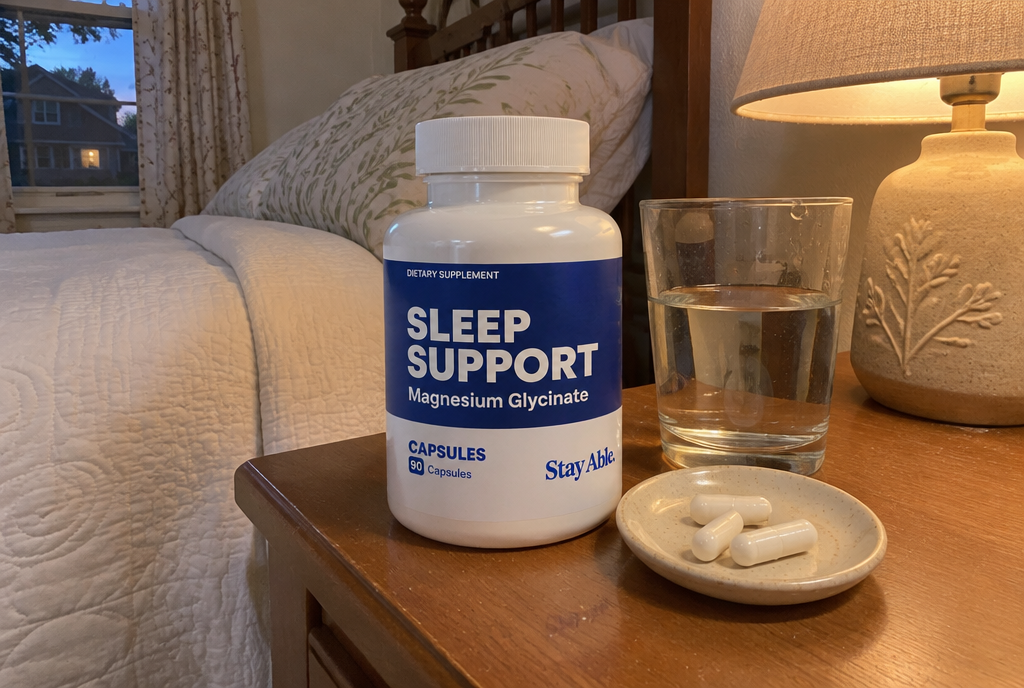
Barb told me two things to look for. Glycinate, because it's gentle on the stomach. And a label that tells you the real amount.
I found Sleep Support from Stay Able:
• 275 mg of magnesium, from 2,500 mg of magnesium glycinate
• No melatonin
• Not a sedative
• Made in the USA
Three capsules with water, about an hour before bed.
What it was like

The first night, I waited for something to hit me. Nothing did. That's the point, but it made me nervous.
It wasn't like the pills. I didn't go down like a stone. Somewhere in the first week or two, I noticed my shoulders weren't up around my ears at bedtime. I'd read a few pages and feel ready.
Some nights took a while. This is not a knockout drop.
But the mornings.
The first morning I woke up clear-headed, I lay there a second, almost suspicious. No cotton mouth. No wet cement. I got up, made the coffee, and remembered why I'd walked into the kitchen.
About three weeks in, I went back to my Tuesday walking group. I told them my knee was better.
What it is not
It is not a sleeping pill, and it won't work like one. If you want to be unconscious in fifteen minutes, this isn't that.
If you take a prescription sleep medicine, don't swap it for this on your own. Talk to your doctor.
And if you have kidney problems or take other medications, check with your doctor or pharmacist first.
Who I'd tell about this
• Melatonin left you groggy, moody or dreaming like crazy
• The PM pills leave you foggy till lunch
• You don't like the idea of needing a pill to sleep
• You want to wake up feeling like yourself
What it costs
$37.99 for a bottle that lasts 30 nights. Or $29.99 a month if you subscribe, with free shipping. About a dollar a night.
And you get 100 days. If you don't like it, send it back for a refund. You've got nothing to lose but the fog.
What other people say
From the Stay Able website, word for word:
"Used to lie there for an hour staring at the ceiling. Now I'm usually out within 20-30 minutes."
Linda R.
"Still wake up sometimes, but I get back to sleep easier than I used to."
Mark T.
"Not magic, but better than nothing."
Joan P.
Questions I had
Will this make me groggy too?
That was my first question. It hasn't. No melatonin, no sedative.
Is it habit-forming?
It's a mineral, the same one that's in spinach and almonds.
How fast does it work?
Not like a pill. A week or two for me. That's why the 100 days matter.
Is it hard on the stomach?
Glycinate is the gentle form. If you get loose stools, take fewer capsules.
Can I take it with my medications?
Ask your pharmacist.
Two ways this can go
You can keep making the trade. A night's sleep for a morning's fog. Missing turns. Quitting the things you like because you can't get going.
Or you can try something that isn't a hormone and isn't a drug, for 100 days, and get your money back if it's not for you.
I got my mornings back. I'd like you to have yours.
P.S. Thirteen hours. That's how long the sleepy stuff in those PM pills can hang around at our age. I think about that every time I pass that aisle. And every time I remember the turn I missed.
Sources: how magnesium intake, absorption and loss change with age, and how many US adults fall short, NIH Office of Dietary Supplements, Magnesium fact sheet; OTC sleep aids on the geriatrics "avoid" list, Int J Clin Pharm 2017; how long the ingredient stays in the body by age, Today's Geriatric Medicine; tested melatonin content versus the label, Sleep Review.
Dramatization. Susan Miller is a persona and her story is illustrative. Individual results vary. These statements have not been evaluated by the Food and Drug Administration. This product is not intended to diagnose, treat, cure, or prevent any disease.