I Fell Asleep Just Fine. It Was 3am That Was Ruining My Days.
For two years I stared at the ceiling until the birds started up. Then a pharmacist told me something about getting older that not one doctor had mentioned. I wish I'd heard it sooner.
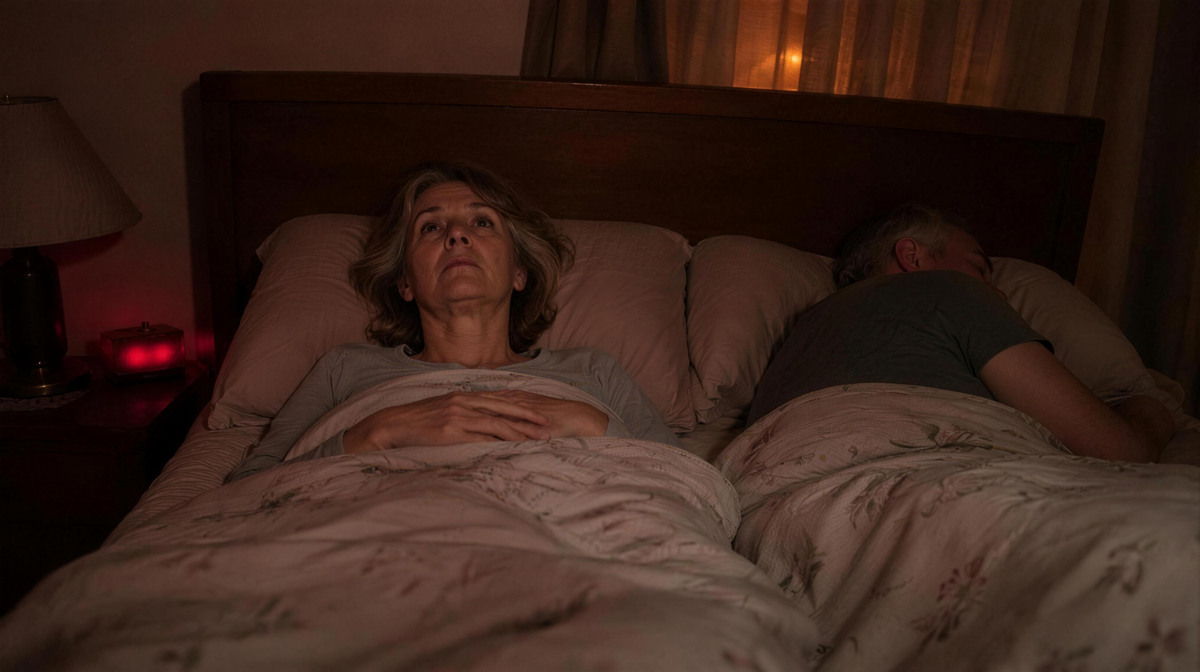
Awake at 3am again?
I was. Almost every night.
3:17, usually. Sometimes 2:50.
Not a bad dream. Not the bathroom. Just wide awake, like somebody flipped a switch.
Falling asleep was never the problem.
I'd be out by 10:30.
It was staying asleep I couldn't do.
So I'd lie there listening to my husband breathe, doing the math. "If I drop off right now, I still get three hours."
I almost never dropped off right now.
What those nights were actually costing me
You know what a 3am night does to the next day. By 2 in the afternoon I was running on fumes. Short with my husband. Reading the same page four times.
I started backing out of things. Told my daughter I had "a busy week" when she asked me to take the grandkids. I didn't. I was just too worn out to chase a four-year-old, and too proud to admit it.
That one still stings. Two years of Saturdays I didn't get back.
I tried everything. I mean everything.
You probably have too.
No coffee after noon. Then no coffee at all. Still up at 3.
Chamomile tea. Lovely. Also sent me to the bathroom at 1am.
No TV or phone after 9. I read paperbacks by lamplight like it was 1974. Still up at 3.
Those blue PM pills. They kept me under. They also left me zonked until lunchtime. Moving through wet cement.
Melatonin. Got me to sleep faster, which I never needed. Did nothing for 3am.
A $90 white noise machine. My husband loves it. That's about all.
I even asked my doctor. He smiled and said, "Susan, sleep changes as we get older."
That was the whole answer. I left feeling like the problem was me.
The pharmacist who actually asked a question

I was picking up a prescription for my husband and griping to the pharmacist, a woman about my age named Denise.
She didn't hand me another box. She asked:
"You fall asleep fine? It's the middle of the night that gets you?"
Yes. Exactly that.
"Has anybody talked to you about magnesium?"
I almost laughed. I'd bought the big orange bottle from the warehouse store. All it did was upset my stomach.
She nodded. "That was probably magnesium oxide. Most of it goes straight through you. That's why your stomach hated it."
Then she told me the part I've been telling everyone since.
What nobody tells you about magnesium after 60
I'm not a scientist. But here's how she explained it. I went home and checked it on the National Institutes of Health site.
Magnesium is the mineral your nerves and muscles use to let go.
Think of making a fist. Calcium is what tightens it. Magnesium is what lets your hand open back up. Your whole body works that way, all night long.
According to the NIH, three things happen as we get older:
1. We eat less magnesium than we used to.
2. Our gut absorbs less of what we do eat.
3. Our kidneys let go of more of it.
Less coming in. More going out. Every year.
Nearly half of American adults already don't get enough from food. Those of us over 60 have it worst.
There I was, cutting out coffee and buying noise machines, and nobody had once mentioned that my body might be running low on the very thing it uses to stay settled.
Denise also mentioned a few small studies on older adults who took magnesium at night. Put together, they fell asleep about 17 minutes faster than the folks on a dummy pill. Small studies. Not the final word. But for a mineral, it was worth a try.
The kind that doesn't upset your stomach
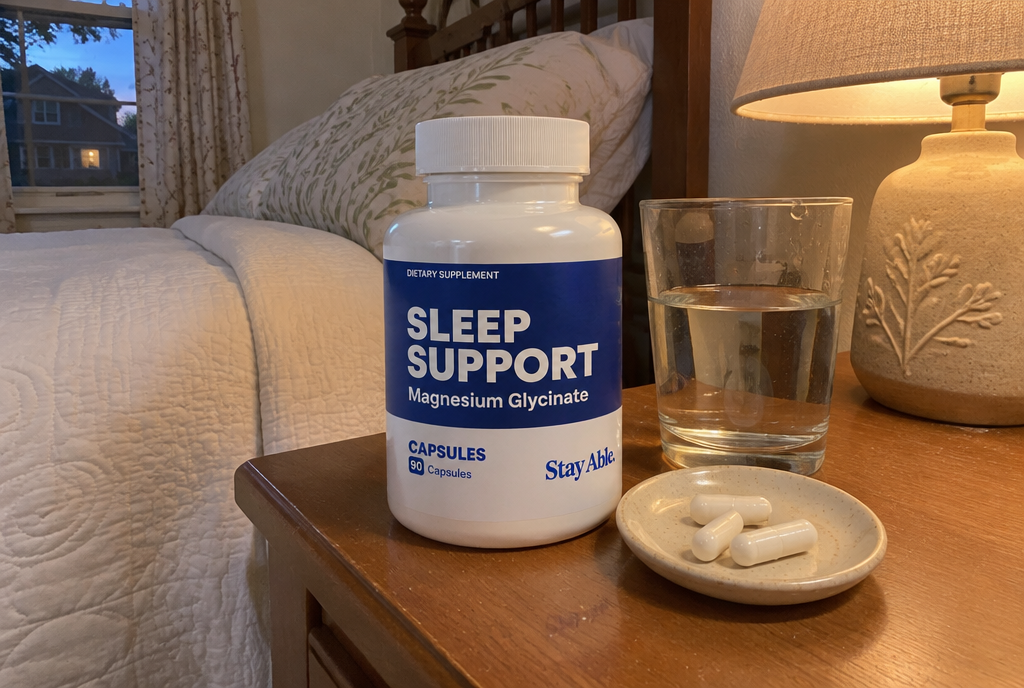
Denise said look for magnesium glycinate. It's joined to glycine and is known for being much easier on the stomach than oxide.
She also told me to flip the bottle over. A lot of brands print a big number on the front that isn't the real amount of magnesium inside.
My daughter found me one that prints both numbers plain as day. Sleep Support, from Stay Able.
• 275 mg of actual magnesium
• From 2,500 mg of magnesium glycinate
• No melatonin. Nothing to knock you out.
• Made in the USA
Three capsules with water, about an hour before bed. That's the whole routine.
What happened (and what didn't)

I'll tell you the truth.
The first week, not much. I still woke up. I told my husband I'd give it till the end of the bottle and then send it back.
Around the second week, something shifted. I still woke at 3. But I wasn't wired. I rolled over, and the next thing I knew it was getting light.
By the end of the first month, I had nights where I didn't see 3am at all. I woke up one morning, looked at the clock, and it said 5:40. I honestly thought it was broken.
And no fog. I got up and I was just... up.
It's not every night. If I have a glass of wine late or something's weighing on me, I can still find myself looking at the ceiling. But it went from almost every night to once in a while. I'll take that trade any day.
I took the grandkids that next Saturday. All day. I even did the slide.
What it is not
It's not a sleeping pill. It won't put you out in 20 minutes, and it isn't meant to.
It's not a cure for anything. If you've slept badly for weeks on end, or you snore and gasp, see your doctor.
And if you have kidney trouble or take prescription medicine, ask your doctor or pharmacist first.
Who I'd tell about this
• You fall asleep fine but you're wide awake at 2, 3 or 4am
• You've tried the teas, the pills and the "sleep hygiene"
• You don't want anything that leaves you groggy
• You tried magnesium once and your stomach hated it
What it costs
One bottle is $37.99 and lasts 30 nights. Subscribe and it's $29.99 a month with free shipping. About a dollar a night.
I spent more than that on tea that did nothing.
And here's what got me off the fence: you get 100 days. If it does nothing for you, you send it back and they refund you. After two years of 3am, that was the only way I was going to try one more thing.
What other people say
From the Stay Able website, word for word:
"Still wake up sometimes, but I get back to sleep easier than I used to."
Mark T.
"Used to lie there for an hour staring at the ceiling. Now I'm usually out within 20-30 minutes."
Linda R.
"Not magic, but better than nothing."
Joan P.
I like that they print the plain ones too.
Questions I had
Will it make me groggy?
It didn't for me. No melatonin, nothing sedating. It's a mineral.
How long till I notice anything?
About two weeks for me. Give it a fair run. That's what the 100 days are for.
I tried magnesium and it upset my stomach.
So did I. That was oxide. Glycinate is the gentle kind.
Why three capsules?
That's what it takes to fit 275 mg of real magnesium in the glycinate form.
Can I take it with my medications?
Ask your pharmacist. Usually two hours apart from some antibiotics, thyroid medicine and bone medicines.
You've got two choices tonight
You can keep doing what you're doing. Fall asleep fine, wake at 3, do the math, drag through tomorrow, and keep backing out of the things you actually want to do.
Or you can try three capsules an hour before bed for a few weeks and see what happens. If nothing does, you get your money back.
I wish somebody had told me two years sooner. Those nights aren't coming back.
P.S. If you remember one thing: the NIH says we take in less magnesium, absorb less and lose more as we get older. I'd never once heard that. Now you have.
Sources: how magnesium intake, absorption and loss change with age, and how many US adults fall short, NIH Office of Dietary Supplements, Magnesium fact sheet; three small trials in older adults, Mah & Pitre 2021, BMC Complementary Medicine and Therapies.
Dramatization. Susan Miller is a persona and her story is illustrative. Individual results vary. These statements have not been evaluated by the Food and Drug Administration. This product is not intended to diagnose, treat, cure, or prevent any disease.