
Nine Days on My Weight-Loss Shot Without Going. My Doctor’s Advice Made It Worse. Then a Pharmacist Explained Why.

I had a number in my head at all times.
Not my weight. Not my dose. The number of days since I’d last been able to go.
That morning it was nine, and I stood in my kitchen doing the arithmetic again to make sure I had it right. Saturday. It had been the Saturday before last.
Nine days is the kind of number you don’t say out loud to anybody.
The math I was doing every morning
If you’re on one of the weight-loss shots, you may already know what I’m talking about.
It starts small. Two days instead of one, and you think nothing of it. Then three, and you figure it’ll pass.
Over a few months, it got to where the better part of a week was normal for me, and I’d stopped expecting anything different.
The bloating was the part that made it hard to ignore.
By day five, my stomach was tight and swollen, and none of my clothes sat right, which is its own joke when you’ve just lost twenty-four pounds.
I’d get dressed for work and look about the same size as I had at the start, because everything I’d eaten in the past week was still in there.
And when it finally did happen, it wasn’t a relief. It hurt. I’ll spare you the details. If you know, you know.
Somebody in an online review said, “stools are like a rock,” and I read that sentence and thought, well, at least I’m not making it up.
The part I didn’t say out loud to anyone

Here’s what I want to say about this, because I don’t think anyone else does.
I told nobody.
Not my husband, who I’ve been married to for nineteen years.
Not the friend I tell everything to.
When my sister asked how the shot was going, I said “a little bloated” and left it at that.
I researched it at midnight, on my phone, in bed, with the brightness turned down. Every few nights, for months.
That’s a strange thing to admit in public, but I suspect a lot of you are doing exactly the same thing right now, which is sort of the point of me writing this.
Nausea you can complain about. People understand nausea.
There’s no polite way to bring this one up. And even thinking about it made me feel embarrassed and desperate.
So you deal with it alone.
Which means the only information you get is whatever you can find online. And most of it is other people just as stuck as you are.
Some of what I read scared me. People describing ten days, twelve days. People who ended up in the emergency room over it.
I’d lie there wondering how far I was from that. Whether nine days was just uncomfortable or the start of something more serious.
That’s a bad thing to be wondering about on your own at midnight.
What my doctor told me to do

I finally brought it up with my doctor, at an appointment about something else entirely, once I’d run out of other things to talk about.
She was good about it. Not remotely surprised. She said it’s one of the most common things she hears from people on these medications.
And she told me what you’d expect her to tell me, because it’s the correct advice.
Drink more water. Eat more fiber. Try Miralax if you need it; that’s what it’s there for.
All sensible. All the standard answers for constipation.
I did all of it, and I didn’t cut corners. For six weeks.
And guess what? Nothing worked.
Everything I tried, in order
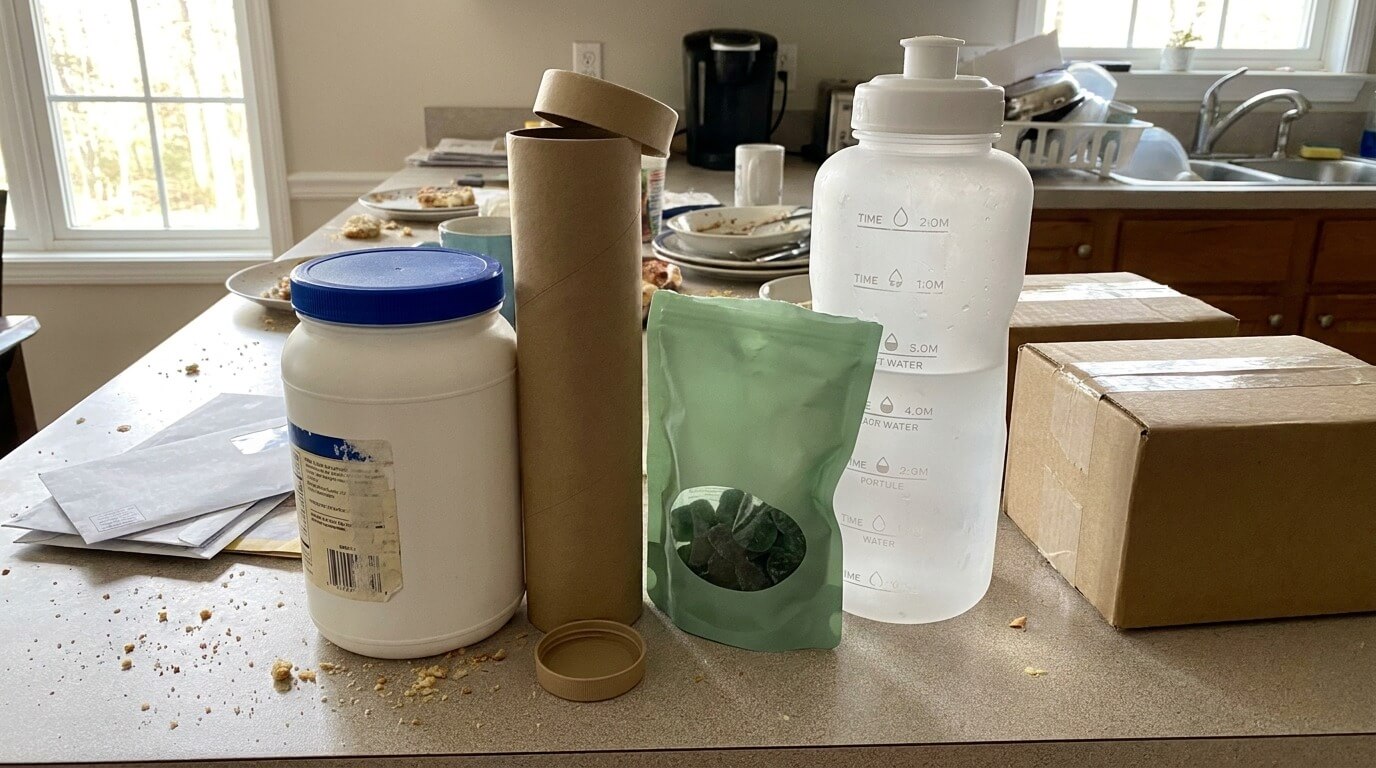
Water.
I bought the enormous bottle that I drank and refilled over and over. Weeks of it.
Not one bit of difference, and I couldn’t understand why.
Fiber.
The obvious one. I bought a tub of fiber powder and started taking it twice a day like the label said.
It made me worse. Tight and gassy and swollen on top of everything else. I stopped after ten days.
The green gummies.
My sister-in-law is devoted to them, the ones that claim to cover your whole day’s nutrition and have “prebiotic fiber” on the label.
I took them for two weeks and felt more bloated, not less, and once again had no idea why.
Miralax.
This one worked, in the sense that it got me through the day. It never changed what was happening the rest of the week, so I'd be reaching for it again a few days later.
And half the time I'd get diarrhea bad enough to keep me in the bathroom for an hour at a time.
Eating less, and eating blander.
This was the one that made most sense to me at the time and turned out to be the worst idea of all.
When you’re queasy, you gravitate to crackers and toast and plain things, and I did, and it made the whole problem worse.
Then I stopped trying.
I bought bigger clothes for the back half of the week. I planned around it.
That’s where I was when a pharmacist changed the whole thing in about five minutes.
“Can I ask you something odd?”

I was picking up my prescription, and I’d put a box of stool softeners on the counter, which was the fourth or fifth time I’d bought them from her.
She scanned them, and then she said, gently, “Can I ask you something odd?”
I nodded, a little embarrassed.
“How much are you actually drinking? Not how much are you supposed to be. How much are you drinking?”
I told her, honestly, that I was doing a whole big bottle a day and had been for weeks, and it wasn’t making any difference.
“Right,” she said. “And when did you last feel thirsty?”
I stood there. I could not answer that question.
I couldn’t remember the last time I’d wanted a drink. Not needed one, not scheduled one. Wanted one.
“That’s the medication,” she said. “Everybody knows it turns down your appetite. Almost nobody knows it turns your thirst down at the same time. So you’re not ignoring the signal. There isn’t one.”
I said the bottle hadn’t made any difference at all.
“It helps. It’s just not the whole thing. Water on its own runs straight through you if there’s nothing with it. You normally get the minerals that hold onto it from food, and you’re not eating much.”
Three things, and I’d only been fixing one
Then she explained the part that made everything else make sense.
“You know the medication slows your stomach down, right? That’s how it works. That’s the whole point of it.”
I nodded. I did know that.
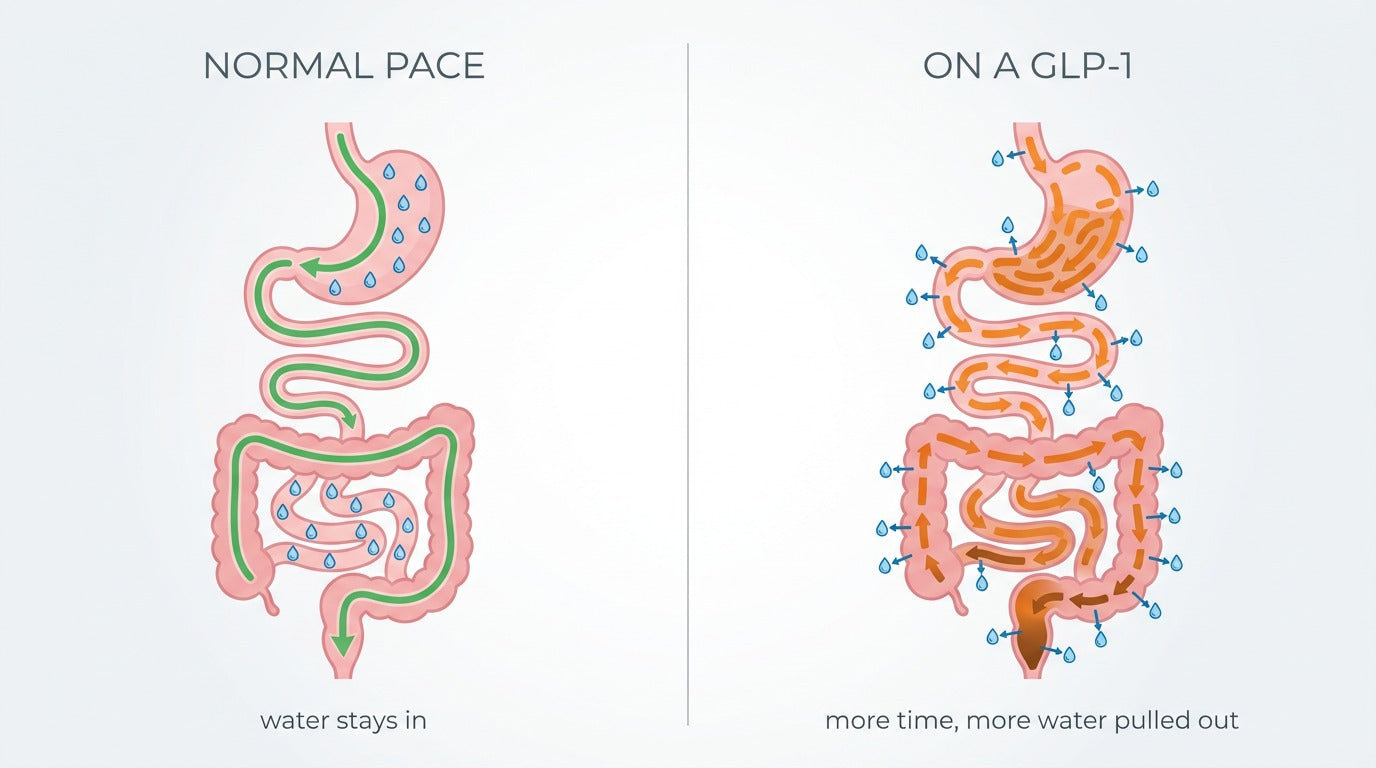
“It doesn’t stop at your stomach. The whole system slows down. Everything moves through you slower than it used to.”
“The longer it takes to get through, the more water gets pulled out of it along the way. That’s the job of that part of your body. So by the time it reaches the end, it’s been sitting there a lot longer than it should have, and it’s a lot drier than it should be.”
That was the first sentence anybody had said to me that explained what I was living with.
“Now put the two together,” she said. “Everything’s moving slower, so more water comes out of it."
"And you’re drinking to a schedule instead of because you’re thirsty, without the minerals that hold onto any of it. You’ve been doing the right thing and still coming up short.”
So I told her about the fiber. That I’d done what I was told and ended up bloated and worse.
She didn’t look at all surprised.
“That’s the third thing, and it’s the one that catches most people,” she said. “There’s more than one kind of fiber. Some of it your gut bacteria feed on, and when they do, they make gas.”
“In a normal system that’s fine; it moves along. In a system that’s been slowed down, the gas has nowhere to go, and neither does anything else.”
I asked whether that was the stuff in the gummies.
“Check the label,” she said. “That’s usually exactly what it is.”
So what am I supposed to do, I asked her.
“Three things, and they only work together. Water with something in it, so it stays in you. The right fiber, the kind that doesn’t ferment. And magnesium, which softens things up rather than forcing anything.”
“Every day,” she said. “Not when it’s already gone wrong. That’s the part people miss.”
I wrote every word of it on the back of my receipt in the parking lot before I forgot it.
Nothing on the shelf was made for this

So I went looking for what she’d written on my receipt. Something to put in my water so it stayed in me. Fiber that wouldn’t ferment. Magnesium.
And I couldn’t find it in one place, or in a form I wanted to deal with.
The fiber tubs were the fermentable kind, mostly, and the labels don’t make it easy to tell which is which. I stood in that aisle reading the backs of boxes with my phone out, looking up ingredients one at a time.
The minerals came as tablets, or as those sports drink packets built for people who sweat for a living.
I’d tried those in the past. They tasted like seawater and made me gag.
The magnesium was on the shelf, in about six different forms, and not one label told me which one I was supposed to want.
She'd said the kind that softens things up rather than forcing them. Some of what was there does the opposite, and you'd have no way of knowing that from the front of the box.
None of it was made for what she'd just described to me. It was all made for regular constipation, not for someone on weight-loss shots.
Then I found Lenia, which is made for someone in my exact situation.
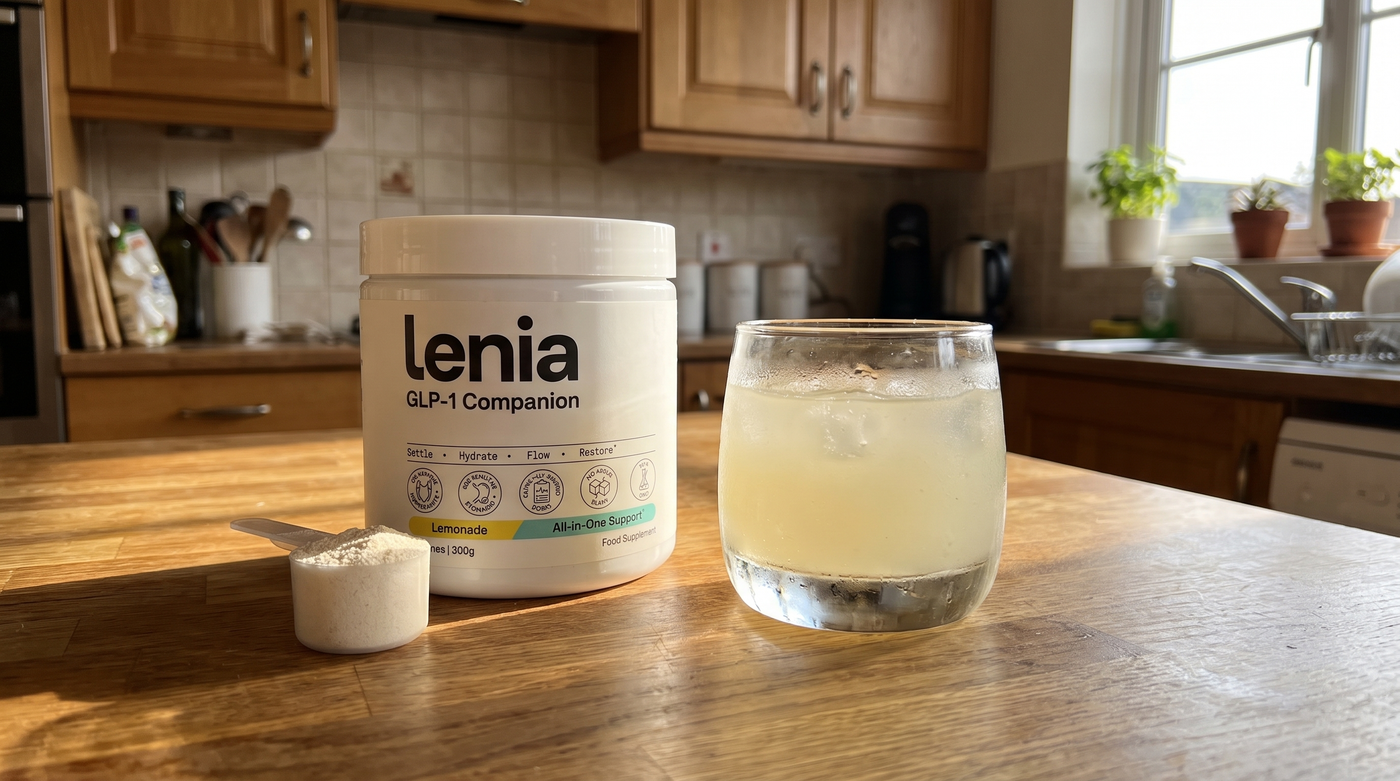
Lenia is a light lemonade. One scoop in cold water, every morning.
Some mornings I drink it straight down. Most mornings it sits next to me, and I finish it over an hour or two, and that’s fine.
That mattered more than I expected. It isn’t a big fiber drink you have to finish before it thickens up, and it isn’t another pill to add to the pile.
It covers all three: the water, the fiber, and the magnesium
B12 and D3
Fill the gaps that open up when you’re eating a lot less than you used to.
What it isn’t, because I checked before I bought
It isn’t one of those “natural GLP-1” products, and it isn’t standing in for your prescription. It doesn’t touch the weight-loss side at all.
Your medication keeps doing that job.
It also isn’t a laxative, which took me a minute to understand. It’s not for emergencies. It’s for every day, which is the whole point.

This is how it went
I’m going to be straight with you.
Because if you’ve been at this as long as I had, you’ve stopped believing anyone who tells you they’ve found the answer.
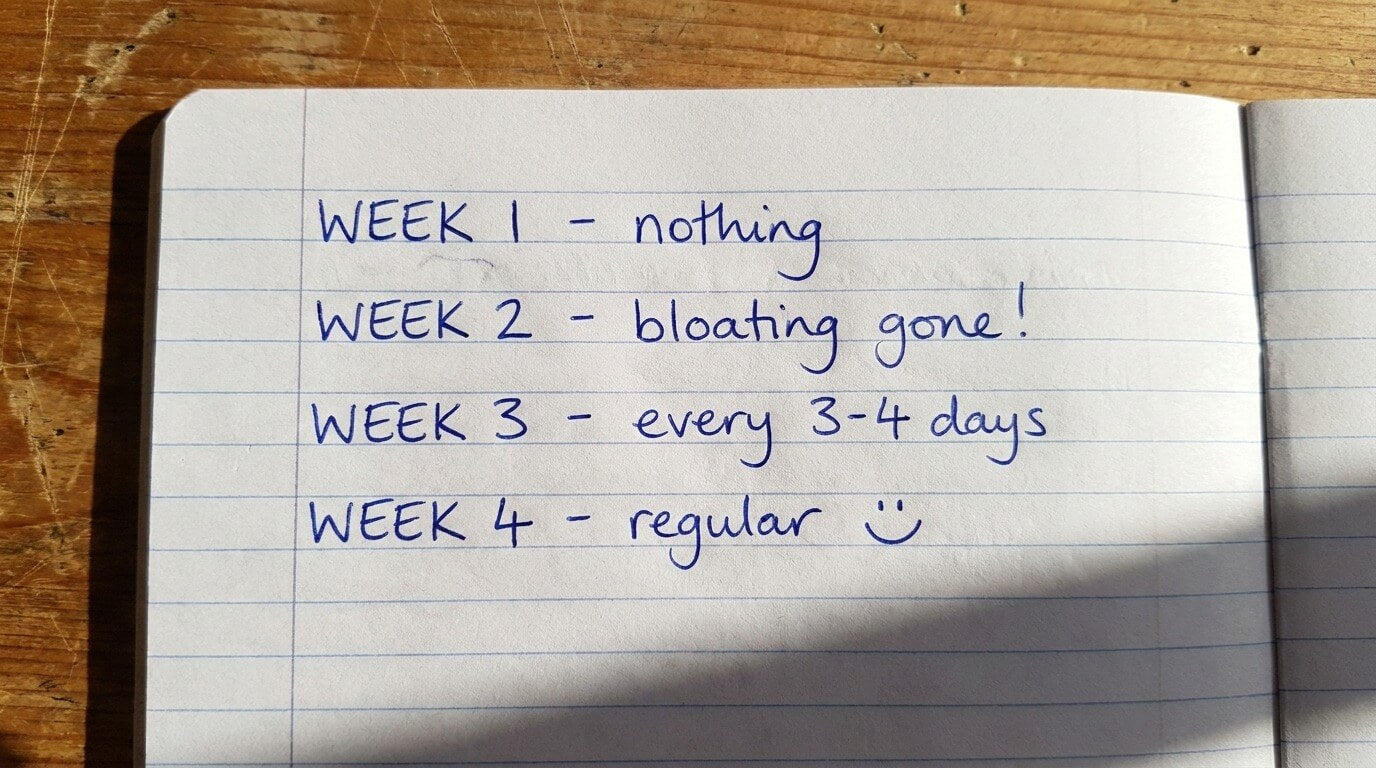
The first week, not much. I drank my lemonade every morning, and things went on about the same.
I remember thinking, here we go again.
But then, something changed.
The bloating went first.
Somewhere around the end of week one, my clothes started sitting the way they were supposed to, which sounds like a small thing and was not a small thing to me.
Week two, I was going every three or four days instead of every six or seven. Not normal yet, but heading that way. And it wasn’t the ordeal it had been.
By week four, I was regular. Not perfect, not clockwork, but close enough that I stopped tracking it.
The whole thing took a month, after I’d spent six of them convinced this was just how it was going to be from now on.
Who this is for
If you’re on a GLP-1 for weight loss and you’re constipated most of the week, this is for you.
It doesn’t matter where you are.
First month and wondering if this is what it’s going to be like now? Six months in and managing it with a laxative every weekend?
This could work for you.
And here’s the one nobody mentions: every time you step up to a higher dose, it gets slower again. Whatever balance you’d found, you’re renegotiating it.
I’d rather have Lenia already on the counter when that happens.
What it costs vs. what it’s worth
I’m not going to pretend Lenia is cheap. But here’s the number that puts it in perspective for me.
My shot runs somewhere between $900 and $1,300 a month at list price. It is comfortably the most expensive thing in my house.
And roughly half the people who start one aren’t still taking it a year later. Side effects are a big part of why.
Lenia is $79.99 for a month’s tub. On subscription, it’s $39.99, half price.
So here’s the question. Is $39.99 worth it to stay on the one thing that’s finally shifting the weight, when the alternative is quitting over something like this?
I’m Not The Only One
“Tried everything. My sister-in-law told me about this. Taste is fine, kind of like a light lemonade. I’d say by the third week things were moving again. Just wish someone had told me sooner.”
“Not an overnight thing so don’t expect that. First week I honestly thought I’d wasted my money. It was more like week two or three before I noticed anything. Now I’m regular for the first time since I started my shot. The bloating went away too which I wasn’t expecting.”
“I was taking a laxative most weekends, half the time I couldn’t leave the house after. This has been way better. 5 stars.”
“My stomach was so tight and swollen by the end of every week. Nothing fit right. That was actually the first thing that changed for me. I’m on my third tub.”
You Might Be Wondering...
No, and I asked my pharmacist before I bought it. There’s nothing in it that changes how the shot works. It doesn’t speed it up, slow it down, or copy it. All it does is give you back the water, minerals, and fiber you stop taking in when you’re eating a lot less. Your medication keeps doing the weight-loss job. If you want to be sure about your own situation, ask your prescriber or your pharmacist.
Fiber is in it, and it’s the kind that won’t leave you bloated, which is more than I can say for the two tubs I bought before this. But fiber on its own was never going to be enough. Everything is moving slower than it used to, and there’s less water in it than there should be, and fiber doesn’t touch either of those. That’s why the minerals and the magnesium are in there too. All three at once, or you’re back to fixing one thing at a time.
I did, for six weeks, out of a bottle with the hours printed on the side. Water alone only gets you so far without the minerals that go with it, and normally you’d be getting those from food. When you’re eating almost nothing, you’re not. So you can drink all day and still be dry where it counts.
That’s what I assumed for six months, and it’s why I said nothing to anybody. It is common. That doesn’t make it the deal you’re stuck with, which is a distinction I wish somebody had drawn for me sooner.
So had I. Miralax most weekends, two tubs of fiber powder, magnesium tablets I picked off the shelf at random.
All of it is made for ordinary constipation, where everything else is working normally. On these shots, your whole system is running slower. So regular fiber ferments and bloats you, water goes straight through without the minerals to hold it, and a laxative only deals with what's already backed up.
You email them and get your money back, any time in the first 90 days. That’s the only reason I risked it.
The 90-day guarantee, or why I risked it
I’d already spent a few hundred dollars on things that didn’t work. I wasn’t ordering on faith.
The deal is this: try it for 90 days.
Use it properly, make sure you drink a glass every day. Consistency is key.
If nothing’s changed, you email them and get your money back. You don’t have to argue your case or mail back a half-used tub.
Which changes the question. Trying it isn’t the risk. The tub is refundable.
The only thing you can’t get a refund on is another two months of going once a week and hoping the problem fixes itself.
So you’ve got two options

Option one. Close this tab. Keep buying laxatives every weekend. Keep going days at a time and hoping this week is different. Keep telling yourself this is the price and you’re lucky to be paying it.
Option two. Try the one thing made for a slowed-down gut. And that handles the water, the fiber, and the magnesium together instead of one at a time.
Worst case, you send it back and get your money back.
Best case, it works the way it worked for me, and in a month you’re regular again and done with the laxatives.
Before you give up on something that’s working for you, at least find out what’s really going on.
It’s a system running slower than it used to, with less water in it than it needs, and the standard advice aimed at the wrong problem. That part you can do something about.
P.S. I’ve got a dose increase coming up next month. Last time I moved up, the whole thing got noticeably worse for a few weeks and I white-knuckled it. I’m going into this one ready.
P.P.S. What I’d change is how long I said nothing. Six months of researching it at midnight when a five-minute conversation fixed it. If that’s you right now, I hope this saves you the same ordeal.

Lenia is a nutritional support product intended to support everyday digestive comfort, hydration and daily nutrients. It is not a GLP-1 medication, a GLP-1 “booster,” or a replacement for your prescribed treatment, and it is not intended to diagnose, treat, cure or prevent any disease. Individual experiences vary. Talk to your prescriber or pharmacist about your own routine.
This website is a marketing piece and the owner has a material financial connection to the provider of the goods referred to on the site. The story and testimonials are illustrative; individual results may vary. These statements have not been evaluated by the Food and Drug Administration.