
My Friend Told Me Exactly What to Do Before My First Weight-Loss Shot. I Blew Her Off, and Week One Almost Ended It.


Six days into my first shot, I sat on the edge of my bathtub at five in the morning, trying to figure out how to tell my husband I was quitting.
I had the whole speech worked out. It's not worth it. I feel worse than I did before. I'll find another way.
I'd waited eleven weeks for that prescription. Two appointments, an insurance appeal, a pharmacy that didn't have it in stock the first time I went.
And six days in, I felt like I was already done.
Here's the part I still think about. My friend Steph had told me, months earlier, exactly how to keep this from happening.
I nodded along. And then I forgot every word of it.
The warning I ignored

Steph started her shot about five months before I did. And she was the reason I asked my doctor about it in the first place. She'd lost weight, and she looked great.
We had lunch a few weeks before my first appointment, and she gave me the whole rundown. How the first month went for her. What she'd change if she did it over.
And the thing she kept coming back to was this: get set up before you start.
Have what you need in the house before you take that first shot, because it hits faster than you think and it pays to be ready.
I said that made sense, and I'd do some research and start prepping. I meant it, in the moment.
And then I went home and did absolutely nothing about it.
It's not that I didn't believe her. I just didn't think it would be that bad.
I'd done keto for a year. I'd counted points. I'd done the shakes, the 5 a.m. gym thing, the plan where you eat nothing but soup. Compared to all that, one shot a week sounded like the easiest thing anybody had ever asked me to do.
That was the mistake. I thought the hard part was over.
Week one: the side effects pile up
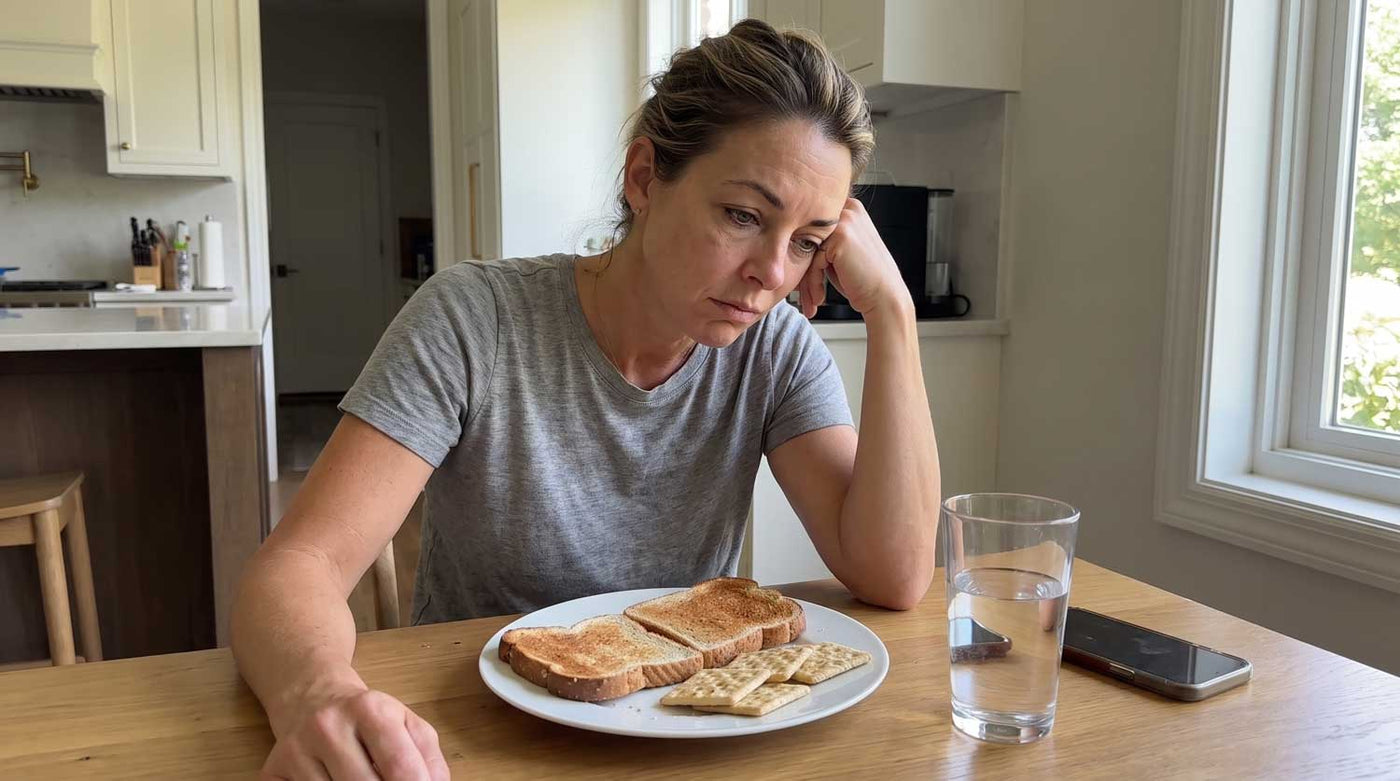
I took my first shot on a Wednesday night.
Thursday I felt fine and a little smug about it.
Friday the nausea started, and it wasn't what I'd pictured.
I thought nausea meant throwing up. This was more like being permanently seasick, and it sat on me all day, and food smells that had never bothered me in my life suddenly did.
Saturday I could barely get out of my chair, I felt so exhausted.
I chalked it up to a bad night's sleep and pushed through it. But the next day I felt even worse, even after eight hours' sleep.
Monday I hadn't had a bowel movement in five days, and I was visibly bloated.
By day six all three were happening at once. Queasy, wiped out, and backed up.
And I want to say plainly that the thing that got to me wasn't any one of them.
It was not knowing if it would ease off in a couple weeks or if I'd signed up for a year of this.
I was on my phone half the night reading.
Some people said it settles down in a week. Some people said it never went away and they quit at month three.
Some people said they barely noticed anything, and I sat there wondering what was wrong with me.
Eleven weeks of waiting, two appointments, an insurance appeal.
And six days in, I was sitting on the bathtub rehearsing how to tell my husband I was quitting.
Week two: I threw everything at it
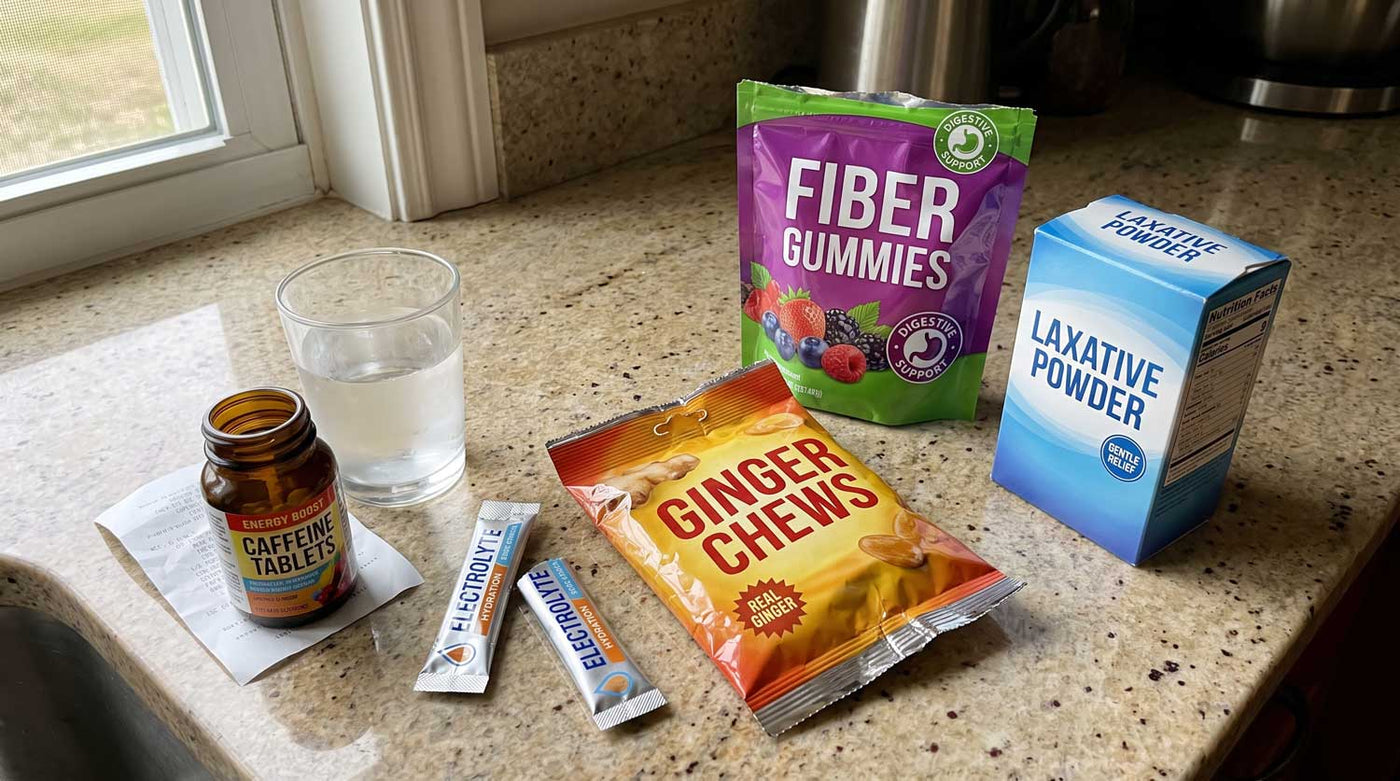
I didn't quit. I went to the drugstore instead, and I bought one thing for every problem I had.
Ginger chews for the nausea, because that's what the internet says.
They helped for about ten minutes at a time, and they're basically candy, which is a rough thing to chew on when your stomach is already turned.
Caffeine tablets for the tiredness.
I got jittery and queasier and still hit a wall at two in the afternoon.
Fiber gummies for the constipation.
These made me worse. Tight and gassy on top of everything else, and I had no idea why, because fiber is supposed to be the answer.
An electrolyte packet somebody recommended in a comment thread.
I got about a third of the way down the glass. It tasted like seawater.
Miralax by the end of that week, when I couldn't wait any longer.
It worked, but the diarrhea was almost as bad as being constipated.
Eating plain food to settle my stomach. Crackers, toast, plain rice.
Which helped the nausea a little, but made the constipation considerably worse.
Six different "solutions" in nine days, roughly ninety dollars down, and I was no better than when I started. Some of it made things worse.
A pharmacist helps me out

I went back for more Miralax the following week, and I set the whole armful down on the counter.
Ginger chews, the gummies, a different electrolyte, the laxative.
The pharmacist looked at the pile. And she said, "Can I save you some money?"
I said please.
"How long have you been on the shot?"
Two weeks, I told her. And then, because I was tired and past caring how it sounded, I told her the rest of it.
The fatigue, the constipation, and the nausea.
She didn't look remotely surprised.
"You're buying one product per symptom," she said. "Can I tell you why that isn't working?"
Three symptoms, same source
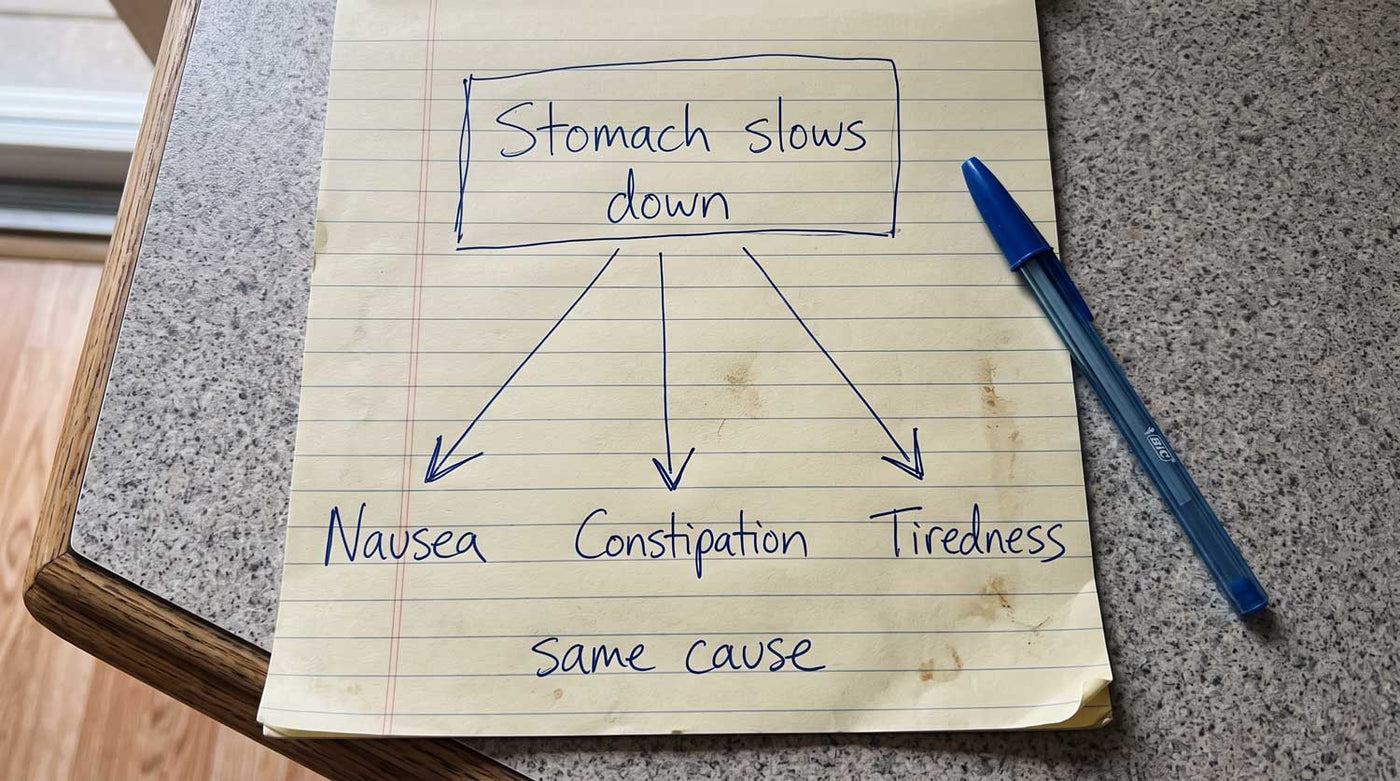
"You know how the medication works, right? It slows your stomach down. That's not a side effect, that's the mechanism. Food sits in you longer, so you feel full and you eat less."
I knew that, vaguely. I'd never once thought about what else it might mean.
"So. Food sitting in a warm stomach for hours longer than it should. That's your nausea. It's pressure, and it's the signals your stomach sends when it's full."
"It doesn't stop at your stomach either. The whole system slows down. Things take longer to move through, and the longer they take, the more water gets pulled out along the way. That's your constipation."
Then she asked me something I couldn't answer.
"When did you last feel thirsty?"
I stood there. I could not remember. Not needed a drink. Wanted one.
"That's the part almost nobody gets told," she said. "It turns your thirst down at the same time as your appetite. So you're not ignoring the signal, there isn't one. You're a little dehydrated and you don't know it, which makes the constipation worse and makes you feel wrung out."
"And you're barely eating, so you're low on the minerals and the B vitamins you'd normally get from food. That's the rest of your tiredness."
She spread her hand over the pile on the counter.
"Every one of these is aimed at a symptom, not at what's causing you to feel this way."
What she told me to do
I asked her what I should have bought.
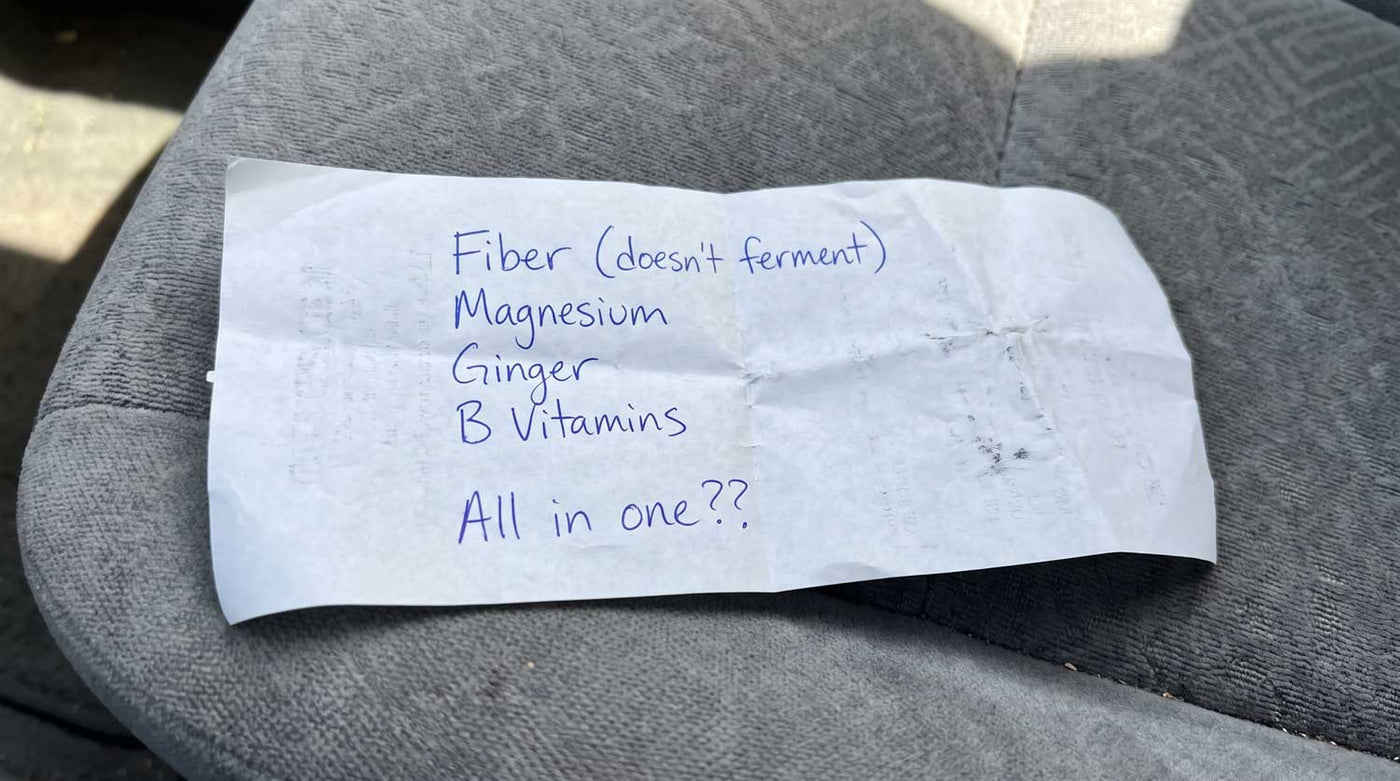
"Water with something in it, so it stays in you. The right kind of fiber, the kind that doesn't ferment, which is not what's in those gummies. Magnesium, which softens things rather than forcing them. Ginger for the queasiness, which you got right. And the B vitamins."
"Every day," she said. "Not when it's already bad. That's the difference between managing this and chasing it."
Then she said the thing that made me want to call Steph and apologize.
"The people who have the easiest time with this are the ones who set it up before their first shot. You're doing it backward. That's harder, but you can still do it."
I wrote it all down on the back of my receipt in the parking lot.
Nothing on the shelf was made for this

So I went looking for what she'd written down, and I couldn't find it in one place or in a form I wanted to deal with.
The fiber tubs were mostly the fermenting kind, and the labels don't make it easy to tell which is which.
I stood in that aisle looking up ingredients on my phone one at a time.
The electrolytes were dosed for people who sweat for a living, and I'd already learned what that tastes like.
The ginger was in candy, which was the last thing I wanted at seven in the morning. And the magnesium came in six forms with nothing on the box to tell me which one she'd meant.
None of it was made for what she'd just described.
It was all built for a body running at normal speed, and mine hadn't been since that first Wednesday.
Then I found Lenia
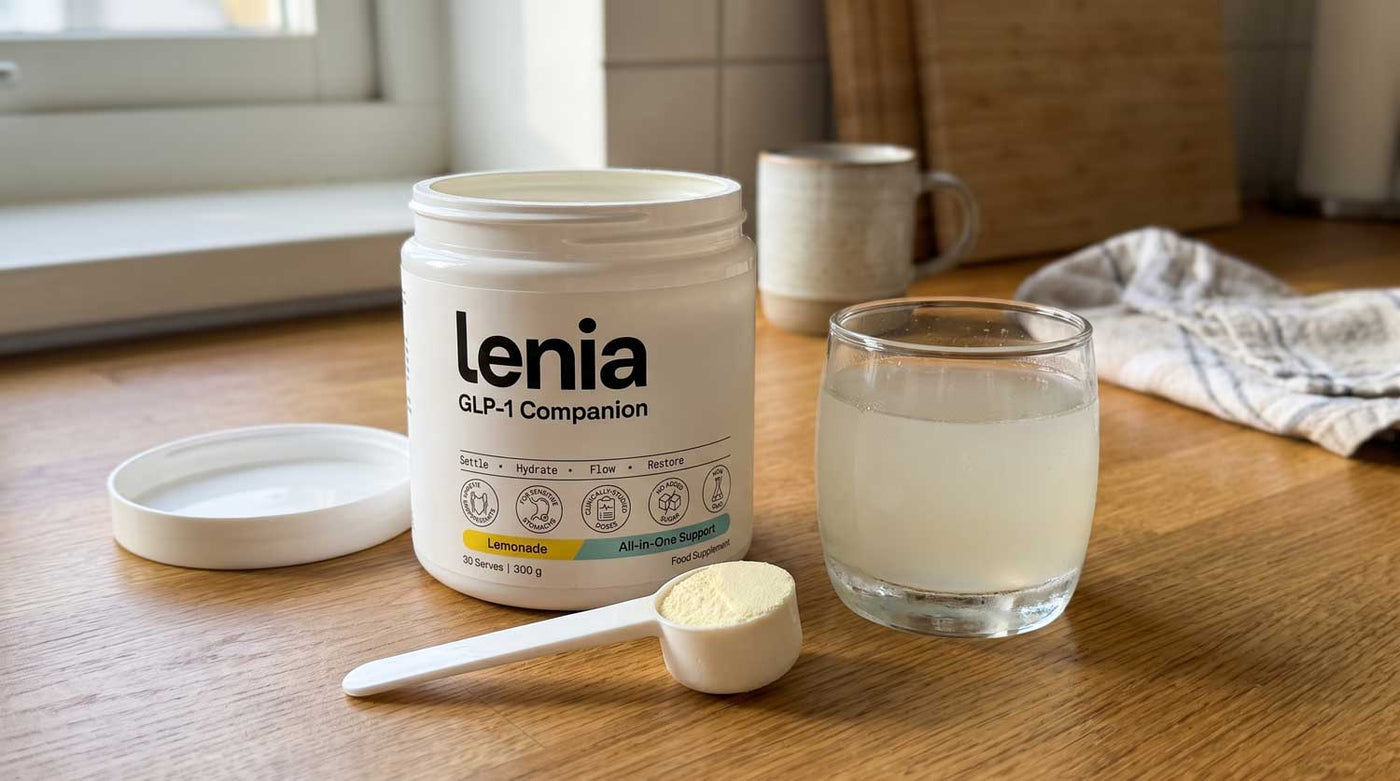
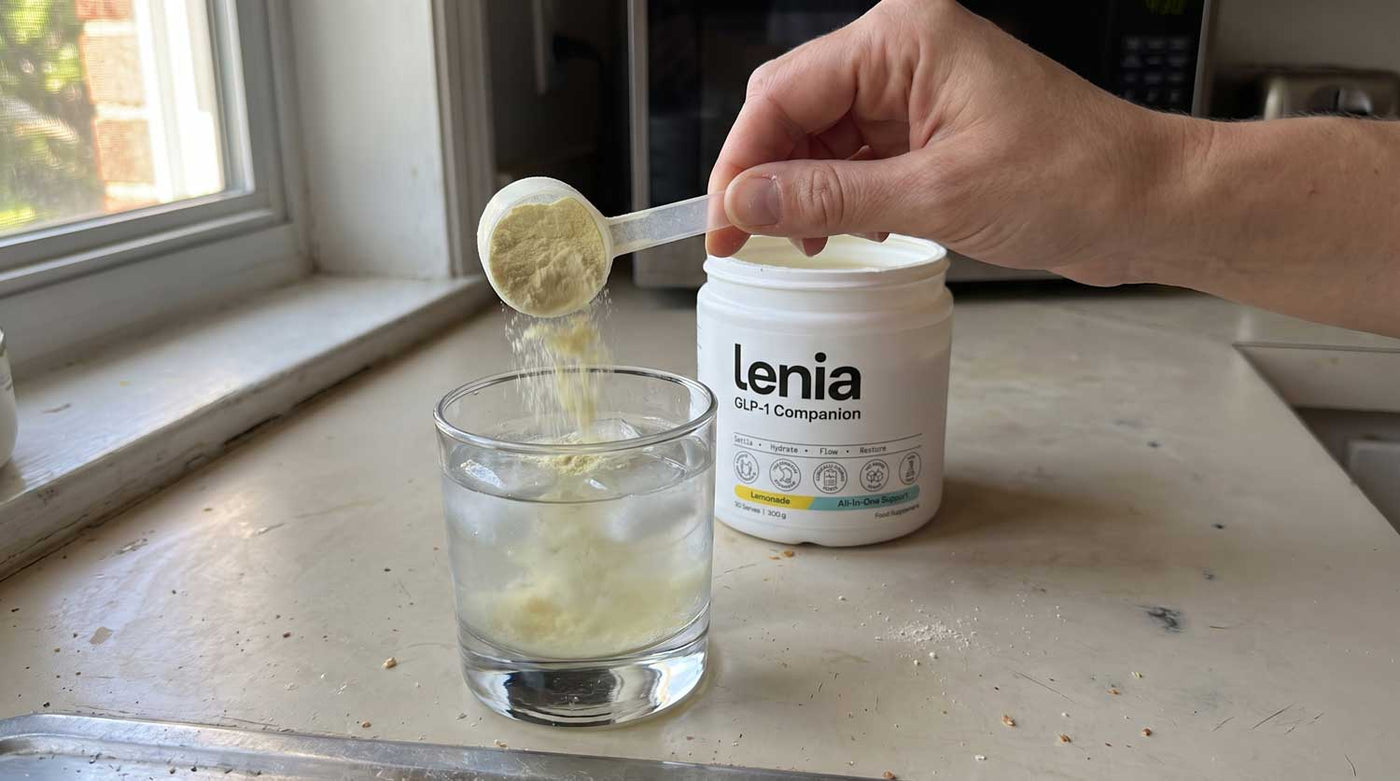
Lenia is a light lemonade. One scoop in cold water, every morning.
Some mornings I drink it straight down. Most mornings it sits next to me and I finish it over an hour or two, and that's fine.
It isn't a pill to time or a shake you have to get through in one sitting, which matters a lot on the mornings when nothing wants to go down.
And it goes after the cause rather than the three symptoms one at a time.
B12 and D3. Fill the gaps that open up when you're eating a lot less than you used to.
What it isn't, because I checked before I bought.
It isn't one of those "natural GLP-1" products, and it isn't standing in for your prescription. It doesn't touch the weight-loss side at all.
Your medication keeps doing that job.

How it went with Lenia
I'm going to be honest about this part, because I started late and I paid for it.
My first month was rough. There's no version of this where I tell you a scoop of lemonade undid a bad start, and I'm not going to pretend otherwise.
What I can tell you is that it got better from there, and faster than I expected.
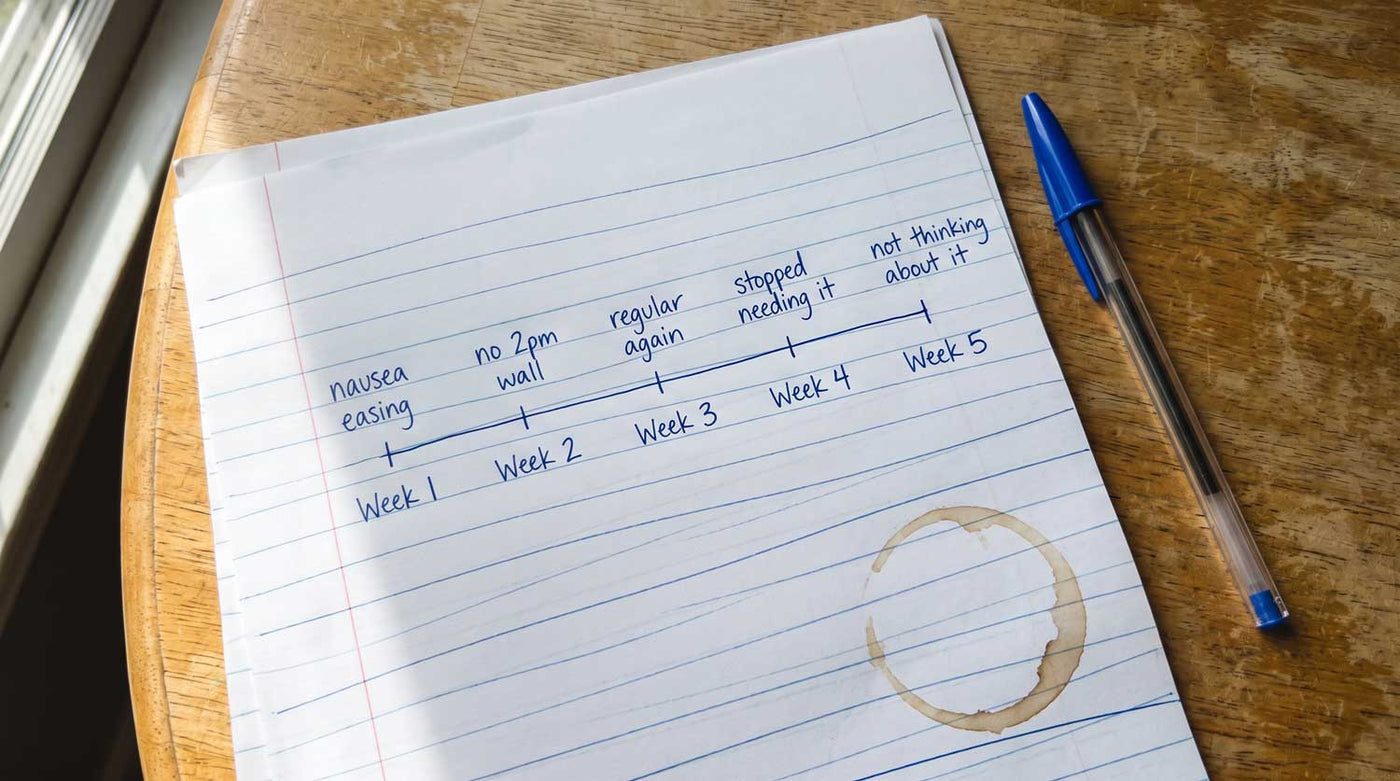
The queasiness eased off first, within the first week or so. Not gone, but I stopped planning my mornings around it.
Then the afternoons. I stopped hitting that two o'clock wall, which I'm fairly sure was the water and the B vitamins, because nothing else in my life changed.
The constipation took longest. Two, maybe three weeks before I'd say I was regular again, and I stopped needing the Miralax somewhere in there.
By the end of the second month I'd stopped thinking about any of it.
And I could focus on what I was here for in the first place: losing weight and feeling good about it.
Who this is for
If you haven't taken your first shot yet, you've got the one thing I didn't: time to get ready before any of this starts.
I can't tell you what your first month would look like either way. Nobody can.
What I can tell you is that mine went badly, that I was two weeks late getting set up, and that I wouldn't do it that way again.
And if you've already started and week one is kicking you, it isn't too late.
I was two weeks in and looking for the exit when I found this. Starting late is harder than starting early, and it still worked.
What it costs vs. what it's worth
I'm not going to pretend Lenia is cheap. But here's the number that puts it in perspective for me.
My shot runs at $1,000 a month. It's comfortably the most expensive thing in my house.
But roughly half the people who start one aren't still taking it a year later. Side effects are a big part of why.
I was close to being one of them.
Lenia is $79.99 for a month's tub. On subscription, it's $39.99, half price.
So here's the question. Is $39.99 worth it to stay on the one thing that's helping you reach your weight loss goals?

I'm Not The Only One
"My sister sent me this before I started and told me not to be a hero about it. I can't tell you what week one would have been like otherwise, but it was nowhere near what I'd been reading online. Taste is fine, kind of a light lemonade."
"Two months in and miserable before I ordered. First week I didn't notice much and figured I'd wasted my money again. Week three was when it turned around for me. Just annoyed at myself for the two months."
"I'd been fine for a couple months and then my doctor moved me up and it was like week one all over again. Except this time I had this. It was a rough couple of days instead of a rough couple of weeks. That's what made me a believer."
"She's got her first appointment next month and I've already sent her a tub. I did the whole thing the hard way and there's no reason for her to. Might be the most useful thing I've bought all year."
You Might Be Wondering...
That's what my friend told me to do, and it's the one thing I'd change. You don't need weeks of preparation. Having it in the house when you take that first shot is the whole idea, so that day three isn't the day you're figuring out what to buy.
No, and I'm the proof of that. I was two weeks in and already looking for the exit. Starting late is harder than starting early and it still worked. You've just got a bit of ground to make up.
No, and I asked my pharmacist before I bought it. Nothing in it changes how the shot works. It doesn't speed it up, slow it down, or copy it. It puts back the water, minerals and vitamins you stop taking in when you're eating a lot less. Your medication keeps doing the weight-loss job. If you have questions about your own situation, ask your prescriber or your pharmacist.
Electrolytes are one part of it, and they're dosed for someone who isn't sweating rather than someone who's just run a race, which is a different amount of salt. But electrolytes on their own wouldn't have touched my nausea or my constipation. That's what the ginger and the fiber and the magnesium are in there for.
So had I. Ginger chews, fiber gummies, caffeine pills, an electrolyte packet I couldn't finish. All of that is built for people whose systems are running normally, where nausea means a stomach bug and constipation means not enough fiber. That's not what's happening here, which is why none of it fit.
You email them and get your money back, any time in the first 90 days. That's the only reason I ordered it, after the ninety dollars I'd already thrown away.
The 90-day guarantee
I'd already wasted money on six things that didn't work, so I wasn't ordering on faith.
Here's the deal: try it for 90 days.
Use it every day, because that's the whole point. If nothing's changed, you email them and get your money back.
You don't have to argue your case or mail back a half-used tub.
Which changes the question. Trying it isn't the risk.
The risk is week one going the way mine did, and you deciding that's what this is going to be like from now on.
So you've got two options

Option one.
Do what I did. Get blindsided on day three, spend a week wondering if you've made a terrible mistake, and get close to quitting.
Option two.
Have it in the house before you need it.
One small drink, sipped in the morning, going after the queasiness, the backed-up feeling, and the wrung-out afternoons before any of them get a chance to build up.
Worst case, you send it back and get your money back.
Best case, week one is nothing like mine, and you can enjoy the benefits without going through everything I did.
P.S. I told Steph she was right. It took me about three months to say it out loud, and she was very gracious about it!
P.P.S. If somebody's already told you to get set up before you start, and you're about to nod and then forget about it, that's the one thing I'd want you to take from all this. Get prepping! You won't regret it.












Lenia is a nutritional support product intended to support everyday digestive comfort, hydration and daily nutrients. It is not a GLP-1 medication, a GLP-1 "booster," or a replacement for your prescribed treatment, and it is not intended to diagnose, treat, cure or prevent any disease. Individual experiences vary. Talk to your prescriber or pharmacist about your own routine.
This website is a marketing piece and the owner has a material financial connection to the provider of the goods referred to on the site. The story and testimonials are illustrative; individual results may vary. These statements have not been evaluated by the Food and Drug Administration.