I Started Taking The Stairs One At A Time. Both Feet On Every Step. Hand On The Rail. At 63.
I thought that was just how mornings were going to be. Six weeks later I was halfway down before I realized I was walking normally. Here's what I changed.
Nobody tells you the day it starts.
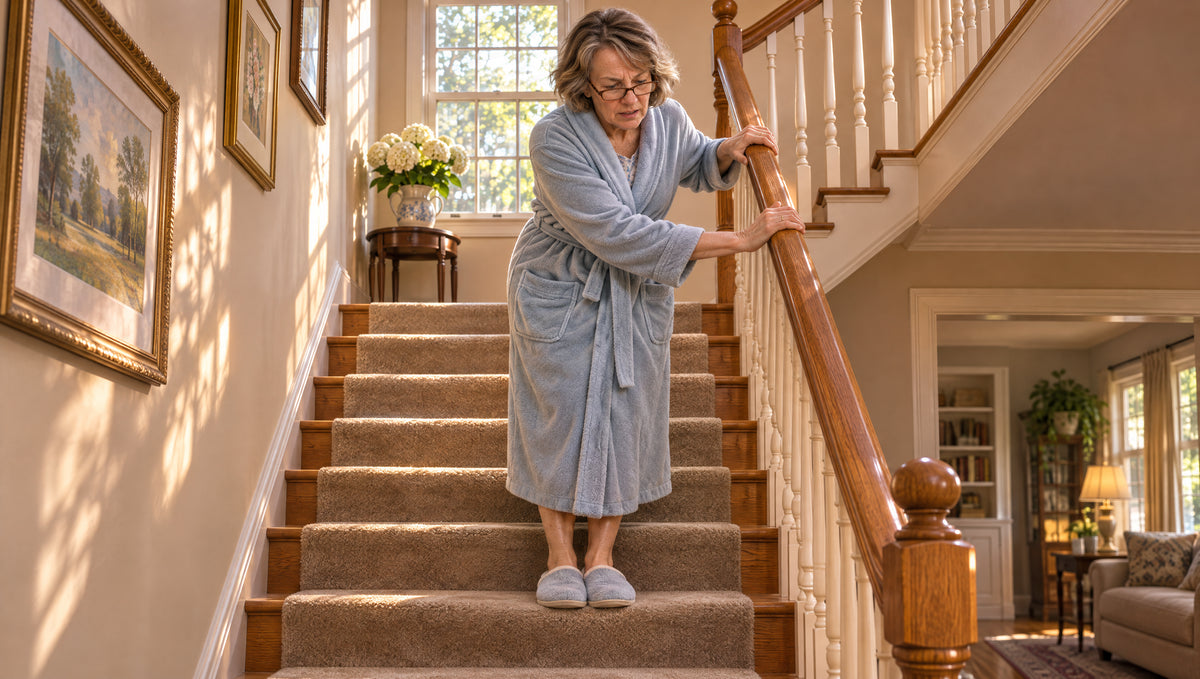
Top of the stairs. Hand on the rail. Right foot. Left foot.
Both feet on every step. All thirteen of them. Like a toddler.
I was 63.
I told myself it was just that morning. It was every morning after that.
The First Half Hour
If you've got it, you know. By lunchtime I was fine. I could walk the dog and do the shopping, and nobody would guess.
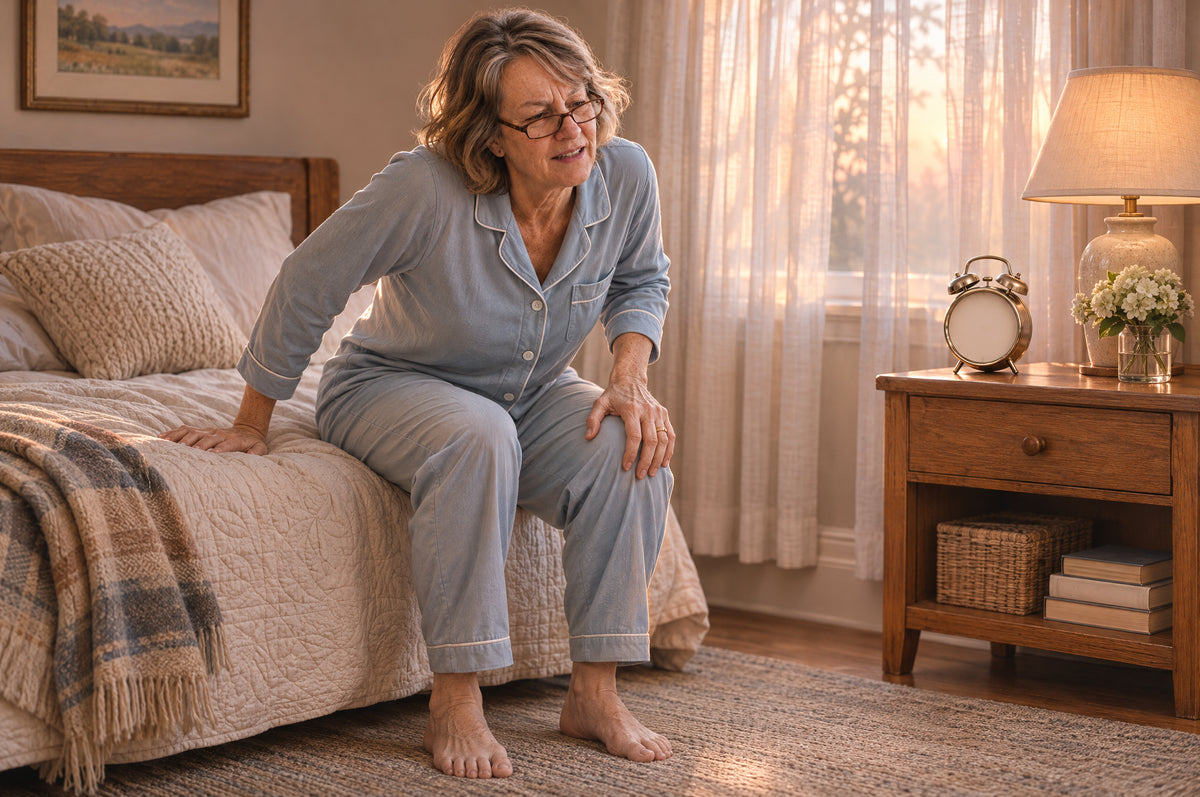
It was the first half hour, every morning. Swinging my legs out of bed and sitting there a minute before I trusted my knees. The slow walk to the bathroom with one hand on the wall. The coffee maker waiting at the bottom while I counted steps.
I started doing things I'm not proud of. I moved my morning pills downstairs so I'd only have to make the trip once. I let my husband think I liked reading in bed until eight. When my daughter stayed over, I waited until I heard her in the kitchen, so she wouldn't see me come down.
I did the math. If this is 63, what's 73? I started looking at one-story houses. We've lived in this house 31 years.
I was not ready to accept that.
I'm 67 now. I took those stairs one at a time for three years before I found out why.
What I Tried
A hot shower first thing. It helped for about as long as the shower lasted.
Stretches from a video, in bed, before getting up. A heating pad on my knees while I read. Glucosamine, for over a year, and I couldn't tell you if it did a thing.
My doctor was nice about it. “A bit of morning stiffness is normal at your age.” Normal didn't get me down the stairs.
What Stairs Do To A Knee
It was my brother-in-law Ray, of all people. He's a retired engineer, he's 70, and he takes his stairs like a teenager. I asked him how. He sent me two things to read.
Put those together and you've got my staircase. The hardest job of the day, on a joint that's running low on its slippery stuff, after eight hours of not moving.
A hot shower was never going to fix that. Neither was glucosamine on its own.
What I Do Now
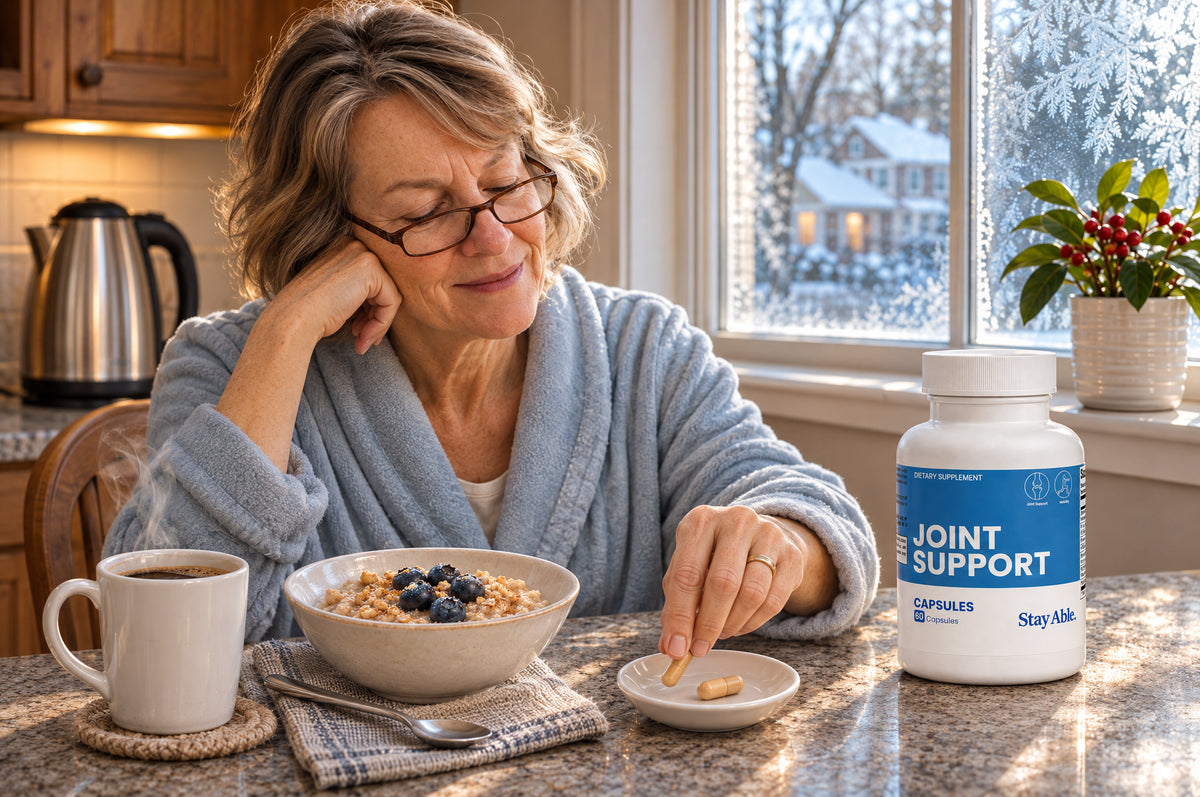
Ray takes Stay Able Joint Support. So now I do too.
Two small capsules with breakfast. That's it.
Seven ingredients, and every amount is printed on the bottle:
MSM: 300 mg
Glucosamine HCl: 200 mg
Turmeric root: 200 mg
White willow bark extract: 150 mg
Boswellia serrata, 65% boswellic acids: 100 mg
Black pepper extract, 95% piperine: 10 mg
Hyaluronic acid: 10 mg
The hyaluronic acid is the same slippery stuff that's in your joint fluid. The boswellia, the turmeric with black pepper and the willow bark are there for the ache. The MSM is for the connective tissue.
How It Went, Week By Week
Weeks 1 and 2. I took my two capsules with breakfast and got on with my day.
Weeks 3 and 4. The mornings came first. Standing up from the bed without sitting there to think about it. The walk to the bathroom was just a walk.
Week 6. Then the stairs. I was halfway down before I realized I was walking one foot after the other. No both-feet. No counting. My hand was on the rail out of habit. I wasn't leaning on it.
Month 3 and on. It kept getting better. I carry the laundry basket down now. I don't think about the stairs at all, which is the whole point.

We've stopped looking at one-story houses.
Some people notice it in the first half hour of the day by week 4. By week 8 you'll know, on the stairs. You have 100 days to decide.
Who This Is For
Anyone who takes the stairs a little slower than they used to. Anyone whose first half hour is the worst part of the day. Anyone who's quietly started planning their mornings around their knees.
What It Costs
I'd start with three bottles. Right now it's buy two, get one free: $75.98 for all three. That's about $25 a bottle, less than a dollar a day. It took me six weeks to notice, and one bottle only lasts four. If you'd rather try a single bottle first, it's $37.99.
You get a 100-day money-back guarantee. It took me six weeks to walk down my stairs the way I used to, so 100 days is plenty of time to see it for yourself. If you're not happy, send it back for a full refund. No forms, no fuss.
Rated 4.9 and trusted by 4,000+ customers.
Quick Answers
How long before I notice anything?
For me, mornings got easier in weeks three and four, and the stairs changed in week six. Some people notice easier mornings in weeks three to four. Most notice by week eight. You have 100 days to decide.
How do I take it?
Two capsules with breakfast, every day. I keep the bottle next to the coffee maker so I never miss.
Can I take it with my medication?
Show the label to your doctor or pharmacist first, especially if you take aspirin or a blood thinner. It has white willow bark and turmeric in it, which is why they ask.
I took glucosamine and couldn't tell if it did anything. How is this different?
Same here. Glucosamine was one ingredient. This is seven in two capsules, including hyaluronic acid, boswellia and turmeric with black pepper. It's what got me walking down my stairs again.
Do I have to sign up for a subscription?
No. You can pay once, with no subscription. If you do subscribe, you save 25% on every order, and you can pause or cancel anytime.
Your Two Choices
You can keep taking the stairs one at a time, and keep an eye on the one-story listings.
Thirteen steps. I used to count every one. Now the coffee's still waiting at the bottom. I just get there sooner.
Start two capsules with breakfast tomorrow.
You'll know by week 8. You have 100 days to decide. Full refund if it's not for you.
P.S. If you count your steps too, start today. It took me six weeks, and the 100-day guarantee covers every one of them.
What Customers Say About Joint Support

At 68 I'd pretty much accepted stiff knees in the morning were just part of it. Two capsules with breakfast every day. By the second month I was getting down to the garden beds without thinking twice. That was the shift.

My wife bought it. I figured it would end up in the back of the cabinet. Three months later I'm back to my Saturday golf round and the stairs don't slow me down the way they used to. It earned its spot on the counter.

I retired and wanted to keep up with the grandkids, not watch from the porch. Bottle next to the kettle so I never missed a day. By week six my knees and hips felt a lot more comfortable on our evening walks. That hasn't changed.
Sources: Kutzner et al., Journal of Biomechanics, 2010; Temple-Wong et al., Arthritis Research & Therapy, 2016.
Stay Able Joint Support is a dietary supplement intended to support joint comfort and mobility. It is not a replacement for anything your doctor prescribed, and it is not intended to diagnose, treat, cure or prevent any disease. This is not medical advice; talk to your doctor before changing anything you take. Individual results vary.
This website is a marketing piece and the owner has a material financial connection to the provider of the goods referred to on the site. “Susan Miller” is a narrator persona and this story is a dramatization; it does not describe an individual customer's experience. These statements have not been evaluated by the Food and Drug Administration.