My Dentist Said “Implants or Dentures.” Then He Said the Number: $30,000.
Medicare wouldn't pay a dime. Here's the dollar-a-day habit I started the week I got home.
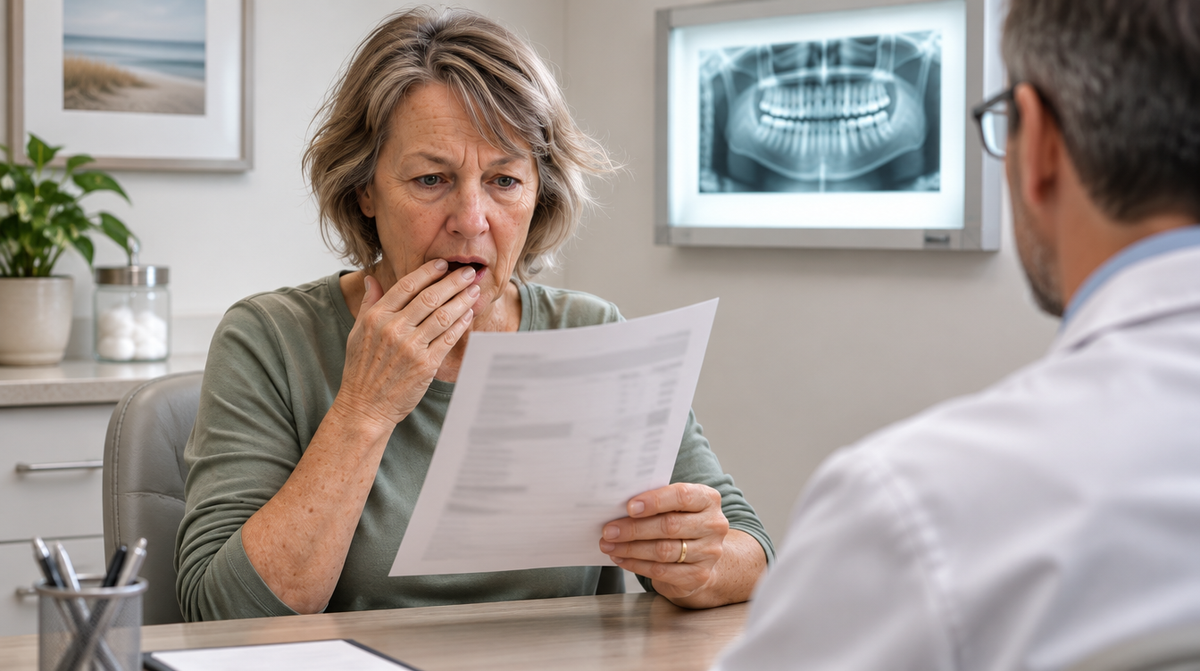
The dentist didn't raise his voice. He just slid a sheet of paper across the desk and tapped the bottom line with his pen.
"If we lose these two," he said, "we're talking implants or a partial denture. And if things keep going the way they're going, a full set of implants would run about thirty thousand dollars."
I'm Susan. I'm 67. I've brushed twice a day since I was in grade school. And I sat in that chair holding a number bigger than the price of my car.
The question everyone asks
I asked it before he'd even put his pen down. "Does Medicare cover any of this?"
It doesn't. In most cases Medicare doesn't pay for routine dental care, fillings, extractions, dentures or implants. You pay the whole bill.
My plan has a dental benefit, sure. It tops out at $1,500 a year. That's about one crown.
Thirty thousand dollars, on a fixed income

That night I sat at the kitchen table with the estimate, a calculator and my checkbook, and did the math three times hoping it would come out different.
Thirty thousand dollars is more than a year of my Social Security. It's the new roof we've been putting off. It's every Christmas present for every grandchild for the rest of my life, and then some.
And the thing that made my stomach drop: one implant alone, a single tooth, is three to five thousand dollars. I had two teeth "on watch."
Everything I looked into
Dental insurance. I called three companies. Every one had a waiting period of up to a year before they'd touch major work, and a yearly cap that wouldn't cover a single implant.
Mexico. My neighbor Barb went to Los Algodones for her crowns. I thought about it for a week. Then I thought about who would drive me, and what happens if something goes wrong when I'm home.
Those dental gummy ads. You've seen them. A "doctor" nobody can look up, a "secret discovery," and a subscription you have to fight to cancel. Barb got stuck in one for four months.
Brushing harder. My hygienist caught that at my next cleaning and told me to stop. Scrubbing harder wears your gums down. It doesn't protect them.
The sentence that changed how I saw it
It was my hygienist, not the dentist, who finally put it plainly. She'd been cleaning my teeth for eleven years.
"Susan, the cheapest tooth is the one you keep."
Then she explained what nobody had ever told me about teeth after 60.
Losing teeth later in life is common. The CDC says about 1 in 4 adults 65 and older have 8 or fewer teeth left. It isn't bad luck. It's ordinary, and that's exactly why it's worth fighting.
A toothbrush only cleans the surface. Researchers have counted around 700 kinds of bacteria living in the human mouth. Most are harmless or helpful. Brushing does very little about the balance of what lives on your tongue, along your gum line and between your teeth.
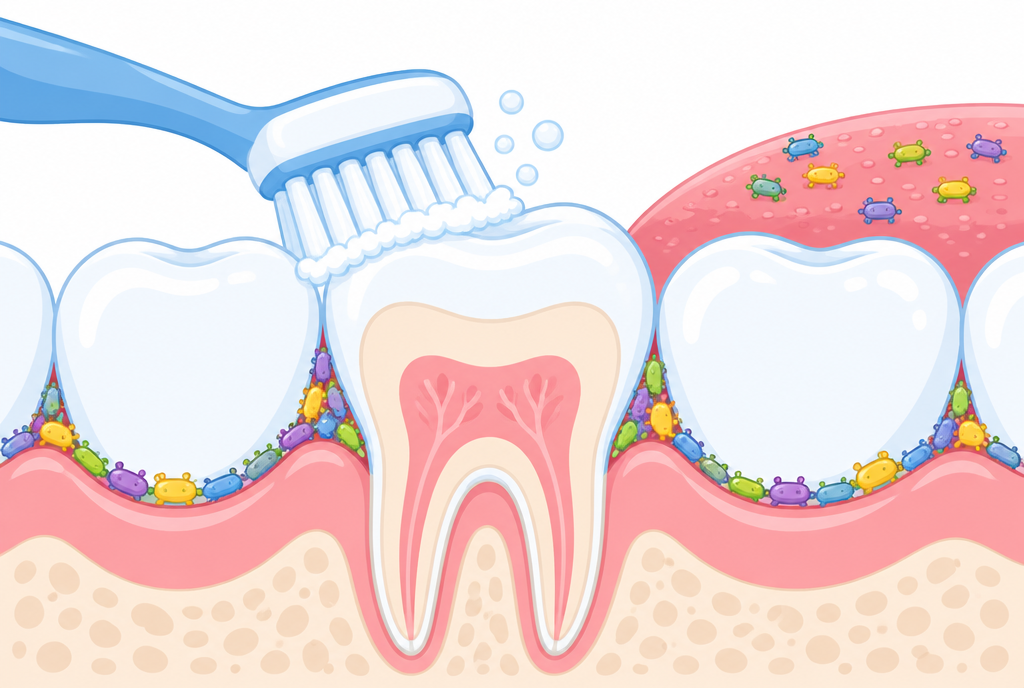
After 60, that balance gets harder to keep. Many of the pills we take, for blood pressure, allergies, mood and sleep, dry the mouth out. The National Institute of Dental and Craniofacial Research says saliva helps protect your teeth, and a dry mouth leaves them more open to decay. I take two of those pills every morning. My mouth had been drier for years and I'd never connected it.
So keep brushing, keep flossing, keep your cleanings, she said. But also look after the balance in your mouth every single day, in a way a toothbrush can't. And she said the three things she'd look for: probiotic strains made for the mouth, not the gut; xylitol instead of sugar; and a chewable, so it works in your mouth instead of going straight to your stomach.
What I found, and why I trusted it
Most bottles I looked at said "proprietary blend" and not much else. One listed every strain by name, the way she'd said to look for.
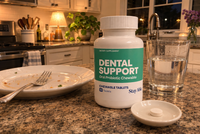
It was called Dental Support, from a company called Stay Able. Three named oral probiotic strains, 4 billion CFU. Xylitol. And hydroxyapatite, the same mineral your tooth enamel is made of. Made in the USA. A 100-day money-back guarantee. And you can buy it once, with no subscription.
The math that finally made sense
I turned the estimate over and did a different sum on the back.
One bottle of Dental Support is $37.99 for a month. At the Buy 2, Get 1 Free price it works out to about $25 a month.
The low end of one implant, $3,000, would pay for nearly ten years of it.
I'm not saying a chewable replaces a dentist, or guarantees I'll never need an implant. Nothing can promise that. But I'd been ready to spend thousands fixing a problem, and I'd never spent a dime on the balance in my mouth.
What I take now
One chewable a day, after dinner, once I've brushed and flossed. It tastes mild, a little fruity, nothing like medicine. I chew it slowly and let it dissolve. That's the whole routine.

Six months later
The first two weeks, nothing. I'll be honest about that.
Around week three my mouth felt cleaner in the morning, and my breath stayed fresher into the afternoon. That dry, sticky feeling when I woke up wasn't as bad.
At my next cleaning, I held my breath while my hygienist went along my gums. When she finished she said, "Nothing new to report. The two on watch are still just on watch." I can't tell you how good that sentence felt. I won't pretend a chewable did that on its own, because I also stopped scrubbing and I never skip the floss. But I'm not changing a routine that's working.
The estimate is still in my kitchen drawer. I haven't needed it.

Who this is for
✓ You still have most of your own teeth, and you'd like to keep them.
✓ You've heard "implant," "crown" or "on watch" at a cleaning and felt your stomach drop.
✓ You're on Medicare and you know it won't pay for dentures or implants.
✓ You take daily medications and your mouth feels drier than it used to.
✓ You'd rather spend a little every month than a lot all at once.
It's not for you if you have a weakened immune system, a serious illness or recent oral surgery, unless your doctor says it's fine first. And if you have a dog, keep the bottle out of reach: xylitol is safe for people but highly toxic to dogs.
What it costs
One bottle is a 30-day supply for $37.99. That's about $1.27 a day.
The best value is Buy 2, Get 1 Free: three bottles for $75.98 instead of $113.97. That's about 84 cents a day, a one-time purchase with nothing to cancel, and it covers the full eight weeks my hygienist says to give anything new.

I'm not the only one

"My hygienist has been on me about my gums for years. I’ve been taking this for two months and she said they looked a little less irritated last visit. Could be the brushing too, but I’m not stopping."

"One capsule after breakfast. No weird taste or anything. My mouth just feels cleaner longer through the day. Simple enough that I don’t forget."

"I hate the dentist. Figured I’d try something at home. Gums don’t bleed as much when I floss now. That’s enough for me to keep taking it."
You might be wondering
Will this save me from needing implants or dentures?
Nobody can honestly promise that, and be wary of anyone who does. What I can tell you is that your daily habits matter, and this is the easiest one I've added. If it hasn't earned its place in 100 days, you get your money back.
I already brush, floss and see my dentist. Why add this?
Keep doing all of it. Brushing cleans the surface of your teeth. Dental Support looks after the balance of bacteria in your mouth, which a toothbrush can't do. They work alongside each other.
How long before I notice anything?
I noticed my mouth felt cleaner around week three. Give it the full eight weeks of daily use.
Is it a subscription trap?
No. You can buy one bottle, or the Buy 2, Get 1 Free bundle, as a one-time purchase. If you choose Subscribe & Save instead, you can pause or cancel anytime.
Will it upset my stomach?
It's one small chewable a day. Xylitol can cause gas or loose stools in large amounts. One tablet is a small amount, but stop and talk to your doctor if you notice any discomfort.
Can I take it with my medications?
If you take prescription medication, have a weakened immune system, a serious illness or recent oral surgery, check with your doctor or pharmacist first.
I have a dog.
Keep the bottle where your dog can't reach it. Xylitol is highly toxic to dogs, even in small amounts. If a dog eats any, call your vet straight away.
The 100-day guarantee
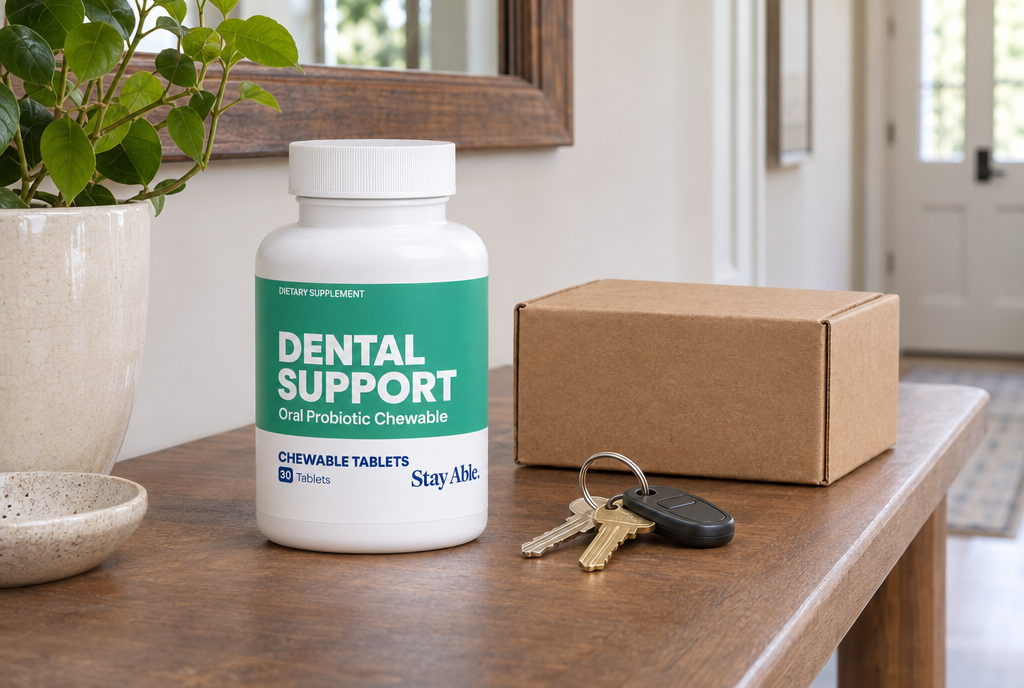
Try Dental Support for 100 days. If it isn't for you, return it within 100 days of delivery for a full refund of the purchase price. No forms, no fuss.
Two choices
You can wait until the dentist slides that piece of paper across the desk.
Or you can spend about a dollar a day looking after the teeth you've still got, starting tonight. I know which one I'd rather pay for.
P.S. Keep your cleanings, and ask your hygienist which teeth she's watching. Write it down, and compare at the next visit.
P.P.S. The cheapest tooth really is the one you keep. I wish someone had told me at 55.
Sources: CDC, Fast Facts: Tooth Loss; Medicare.gov, Dental services; NIDCR, Dry Mouth and Older Adults; Human Oral Microbiome Database.
These statements have not been evaluated by the Food and Drug Administration. This product is not intended to diagnose, treat, cure, or prevent any disease. A supplement isn't a substitute for brushing, flossing or your dentist's advice. Individual experiences vary. Dramatization: Susan Miller is a composite character, and her story is a dramatization.