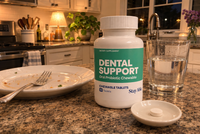
I Watched Mom Put Her Teeth in a Glass Every Night for 22 Years. I Swore That Wouldn't Be Me.
I'm 67 and I still have my own teeth. Here's what nobody told Mom about keeping them after 60.
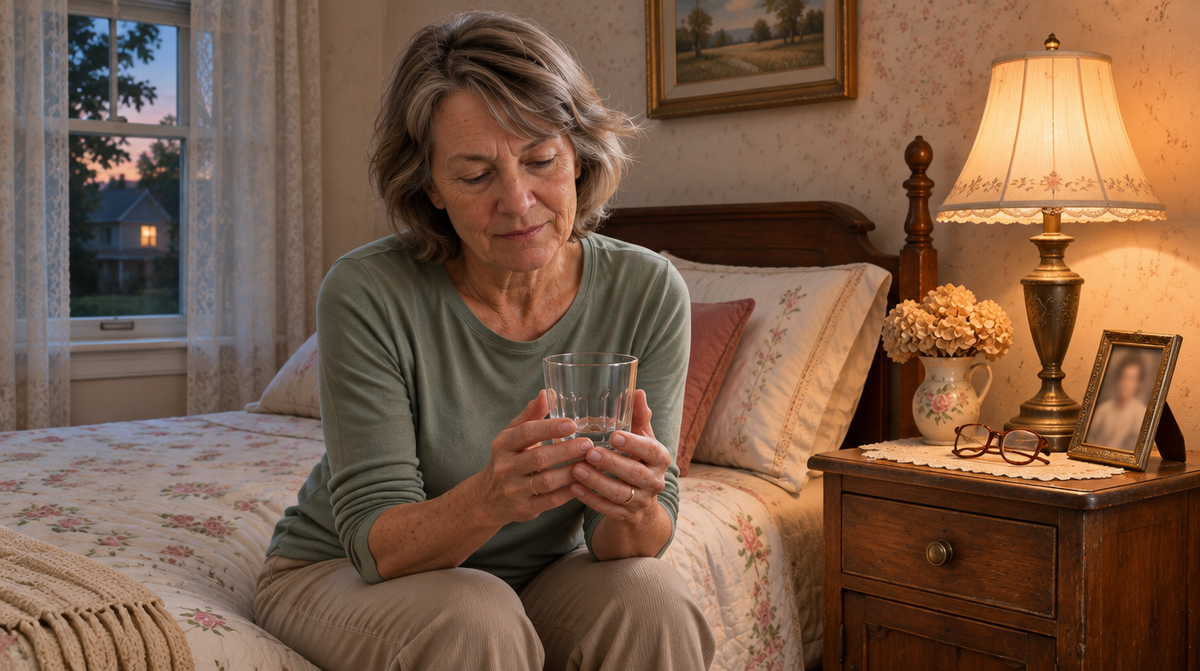
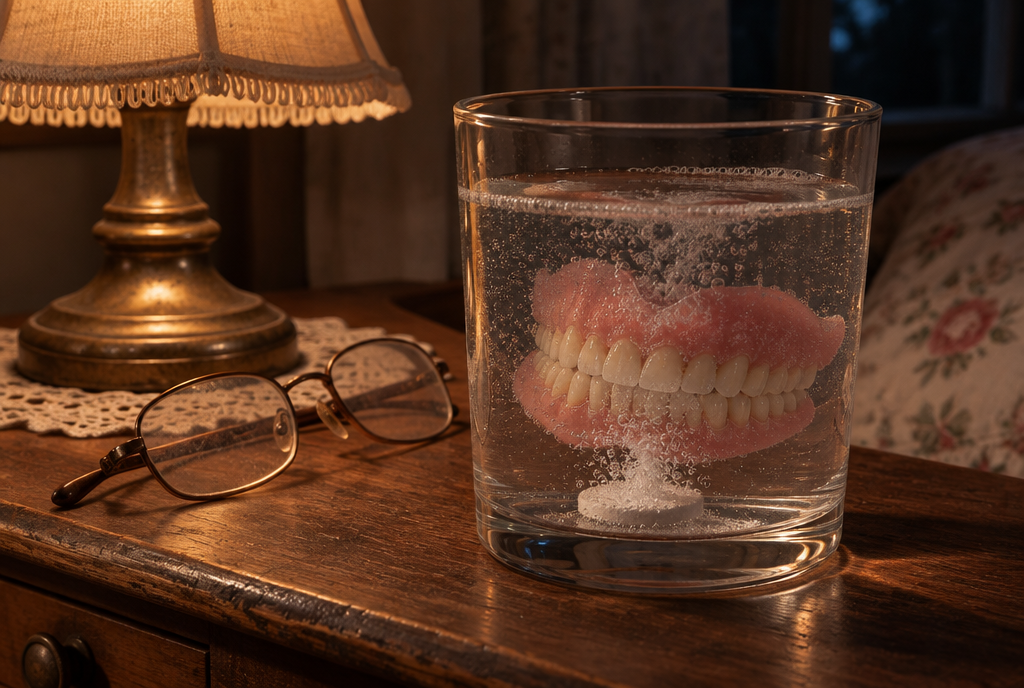
You know the sound if you grew up with it. The fizz of the tablet dropping into the water glass. Then the little click as Mom set her teeth in it, every single night, on the nightstand next to her reading glasses.
Twenty-two years of that sound.
I'm Susan. I'm 67, I live outside Columbus, and I still have my own teeth. Every one of them. I'd like to keep it that way, and I'm guessing that's why you're reading this too.
The glass on the nightstand
Mom got her dentures at 64. She told everyone it was "a relief." It wasn't.
First it was the adhesive. A tube in her purse, a tube in the car, a tube by the bathroom sink. Then corn on the cob went. Then apples, unless I sliced them thin. Then steak. By her seventies, Sunday dinner at her house meant something soft, and she pretended that was her choice.
Every few years her gums shrank and the dentures stopped fitting. They'd rub. They'd slip when she laughed. Her dentist would reline them, she'd get a few good months, and then it started again.
At Thanksgiving one year the top plate came loose mid-sentence. She covered her mouth with her napkin, went to the bathroom, and didn't come back to the table. My granddaughter, who was four, asked why Great-Grandma was sad.
The part nobody talks about
When Mom was 86 she lost some weight, and the dentures stopped fitting for good. Getting them in hurt, so she stopped wearing them. I was the one looking after her by then.
I bought a blender. Soup, oatmeal, the chocolate shakes from the pharmacy. I blended her pot roast. I'm not proud of how often I cried doing it.
I remember standing at her sink rinsing those dentures one night and thinking, very clearly:
I wouldn't wish these on my worst enemy. And I am not ending up here.
Fifty years of doing it right
So I've been the good patient my whole life. Electric toothbrush. Floss every night. A water flosser my son gave me for Christmas. Cleanings every six months, never skipped one, not even the year I had my knee done.
I honestly thought that was the deal: do all that, and you keep your teeth.
The cleaning where the deal changed
Last spring my hygienist was going along my gums with that little measuring tool, calling out numbers. More of them were 4s than I was used to. "Some recession back here," she said. "Pretty common at your age."
Then the dentist came in, looked at my lower left molar, and said, kindly enough, "That one's working hard. If we ever lose it, we'd talk about an implant."
I asked what an implant costs. Three to five thousand dollars. For one tooth. And if a mouth goes the way Mom's did, a full set of implants can run thirty thousand dollars or more.
Then I asked the question every one of us asks. "Does Medicare cover it?"
It doesn't. In most cases Medicare doesn't cover routine dental care, and it doesn't pay for dentures or implants. You pay the whole bill.

I sat in the parking lot with my hands tight on the wheel. I had done everything right for fifty years, and I was still hearing "if we ever lose it."
What I tried first
My first instinct was to brush harder. My hygienist caught that at the next visit and told me to stop. Scrubbing harder wears your gums down. It doesn't protect them.
Then I bought the strongest mouthwash in the drugstore, the one that burns. By the end of the week my mouth felt like sandpaper every morning.
Then I did what we all do and went down the internet rabbit hole. Every dental ad I found had a "doctor" nobody could look up, a "secret discovery," and a subscription you had to fight to cancel. My sister got stuck in one of those for four months. I wasn't falling for it.
What nobody told Mom about teeth after 60
My hygienist is the one who finally explained it, and I wish someone had told Mom. Here's what I didn't know.
Losing teeth in your sixties and seventies is common. The CDC says about 1 in 4 adults 65 and older have 8 or fewer teeth left, and more than 1 in 7 have lost all of them. Mom wasn't unlucky. She was ordinary.
Your mouth is a neighborhood, not a countertop. Researchers have counted around 700 kinds of bacteria living in the human mouth. Most are harmless or helpful. A toothbrush cleans the surface of your teeth. It does very little about the balance of what lives on your tongue, along your gum line and between your teeth.
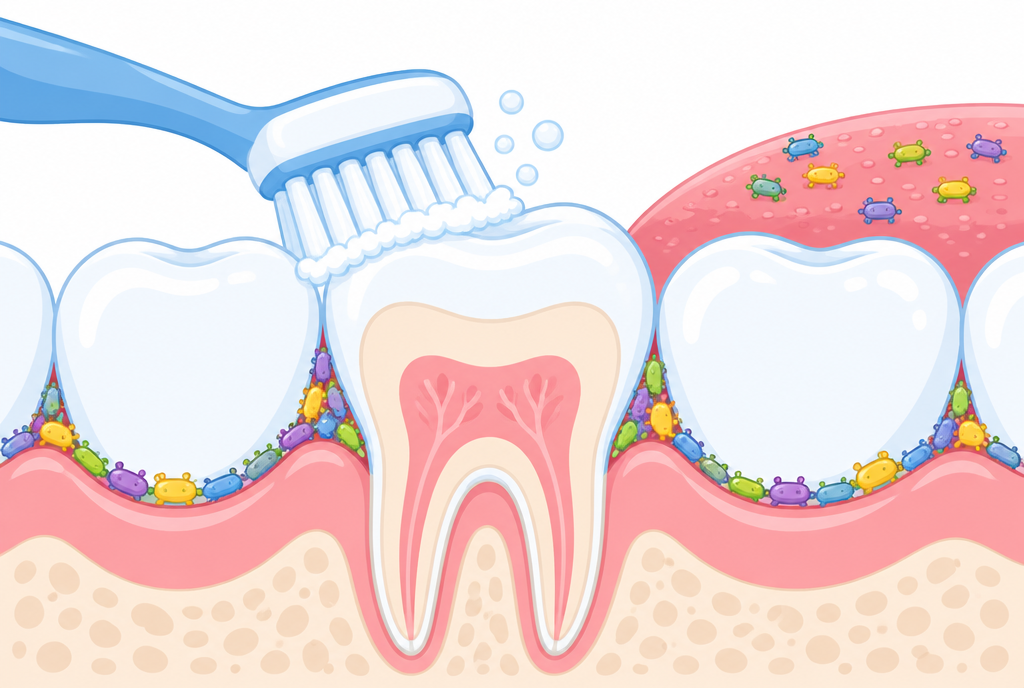
After 60, that balance gets harder to keep. Many of the pills we take, for blood pressure, allergies, mood and sleep, dry the mouth out. The National Institute of Dental and Craniofacial Research says saliva helps protect your teeth, and a dry mouth leaves them more open to decay. Less saliva means less protection, even if you brush perfectly.
So the job changes after 60. You still brush and floss and see the dentist. But you also want to look after the balance in your mouth, every day, in a way a toothbrush can't.
The bottle my hygienist didn't sell me
I asked her what she'd do. She said she couldn't recommend a brand, but she'd look for three things: probiotic strains made for the mouth, not the gut; xylitol instead of sugar; and a chewable, so it works in your mouth instead of going straight to your stomach.
That night I sat at the kitchen table with my reading glasses and compared labels. Most bottles said "proprietary blend" and not much else. One listed every strain by name.
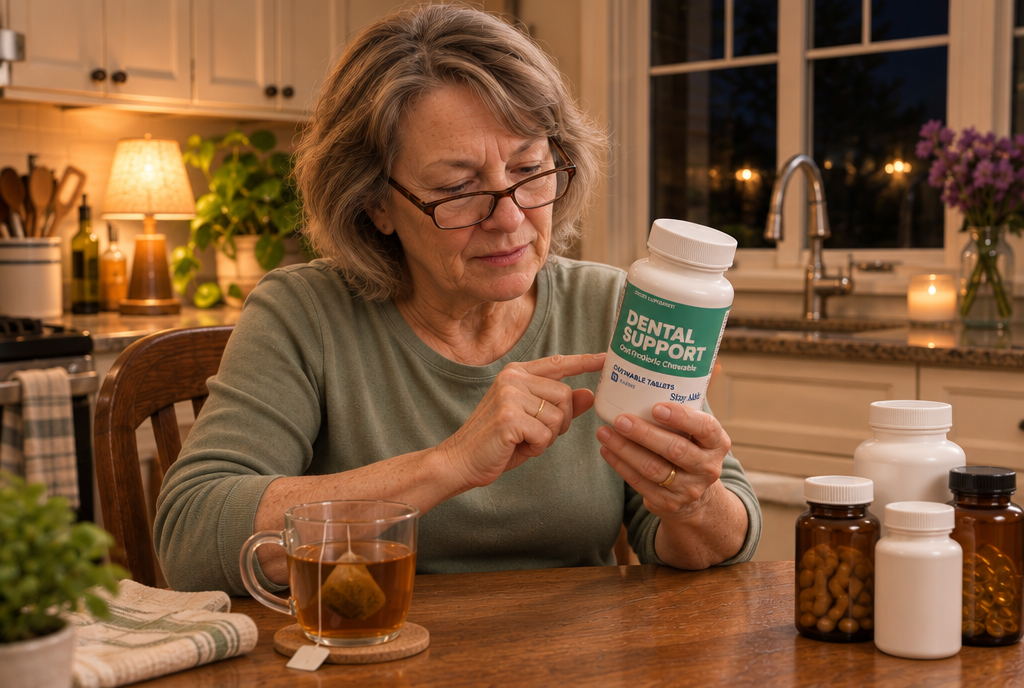
It was called Dental Support, from a company called Stay Able. Three named oral probiotic strains, 4 billion CFU. Xylitol. And hydroxyapatite, the same mineral your tooth enamel is made of. Made in the USA, a 100-day money-back guarantee, and no subscription unless you want one.
What I take now
One chewable a day, after dinner, once I've brushed and flossed. It tastes mild, a little fruity, nothing like medicine. I chew it slowly and let it dissolve. That's the whole routine.

What happened, slowly
Nothing dramatic happened in the first two weeks, and I want to be honest about that.
Around week three, I noticed my mouth felt cleaner in the morning, and my breath stayed fresher into the afternoon. The sandpaper feeling was gone too, but that's because I'd thrown the burning mouthwash out.
At my fall cleaning, my hygienist went along my gums with that same little tool. She said they looked calmer than in the spring. I won't tell you a chewable did that on its own. I'd also stopped scrubbing, and I never skip the floss. But I'm not stopping something that's part of a routine that's working.
And on the Fourth of July I ate corn on the cob, right off the cob, in front of the whole family. Mom would have loved that.

Who this is for
✓ You still have most of your own teeth, and you'd like to keep them.
✓ You watched a parent struggle with dentures, and you quietly promised yourself "not me."
✓ You brush, floss and never miss a cleaning, and you've still heard the words "recession" or "if we ever lose that one."
✓ You take daily medications and your mouth feels drier than it used to.
✓ You're on Medicare and you know what a dental bill can do to a fixed income.
It's not for you if you have a weakened immune system, a serious illness or recent oral surgery, unless your doctor says it's fine first. And if you have a dog, keep the bottle out of reach: xylitol is safe for people but highly toxic to dogs.
What it costs
One bottle is a 30-day supply for $37.99. That's about $1.27 a day.
For comparison, the low end of my dentist's quote for one implant, $3,000, would buy nearly ten years of Dental Support at the 3-for-2 price.
The best value is Buy 2, Get 1 Free: three bottles for $75.98 instead of $113.97. That's a one-time purchase with nothing to cancel, and it covers the full eight weeks my hygienist says to give anything new, with time to spare.

I'm not the only one

"My hygienist has been on me about my gums for years. I’ve been taking this for two months and she said they looked a little less irritated last visit. Could be the brushing too, but I’m not stopping."

"One capsule after breakfast. No weird taste or anything. My mouth just feels cleaner longer through the day. Simple enough that I don’t forget."

"I hate the dentist. Figured I’d try something at home. Gums don’t bleed as much when I floss now. That’s enough for me to keep taking it."
You might be wondering
I already brush, floss and see my dentist. Why add this?
Keep doing all of it. Brushing cleans the surface of your teeth. Dental Support looks after the balance of bacteria in your mouth, which a toothbrush can't do. They work alongside each other.
Will this keep me out of dentures?
Nobody can honestly promise that, and be wary of anyone who does. What I can tell you is that your daily habits matter, and this is the easiest one I've added. If it hasn't earned its place in 100 days, you get your money back.
How long before I notice anything?
I noticed my mouth felt cleaner around week three. Give it the full eight weeks of daily use.
Will it upset my stomach?
It's one small chewable a day. Xylitol can cause gas or loose stools in large amounts. One tablet is a small amount, but stop and talk to your doctor if you notice any discomfort.
Is it a subscription trap?
No. You can buy one bottle, or the Buy 2, Get 1 Free bundle, as a one-time purchase. If you choose Subscribe & Save instead, you can pause or cancel anytime.
Can I take it with my medications?
If you take prescription medication, have a weakened immune system, a serious illness or recent oral surgery, check with your doctor or pharmacist first.
I have a dog.
Keep the bottle where your dog can't reach it. Xylitol is highly toxic to dogs, even in small amounts. If a dog eats any, call your vet straight away.
The 100-day guarantee
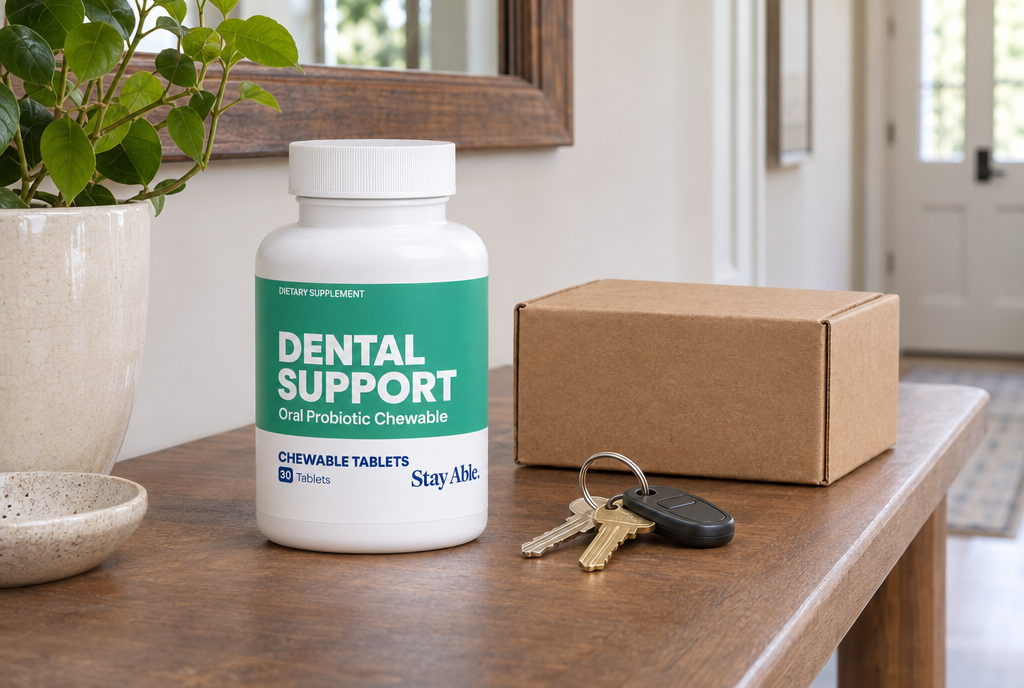
Try Dental Support for 100 days. If it isn't for you, return it within 100 days of delivery for a full refund of the purchase price. No forms, no fuss.
Two choices
You can keep doing exactly what you're doing, and hope.
Or you can add one chewable after dinner, and give the teeth you've looked after for sixty years one more thing on their side. I made that choice for me, and a little bit for Mom.
P.S. If you have a cleaning coming up, keep it. Then ask your hygienist to read you your gum numbers. Write them down, and compare at the next one.
P.P.S. Mom's glass is in my kitchen cabinet now. I drink my water out of it. It reminds me every day what I'm doing this for.
Sources: CDC, Fast Facts: Tooth Loss; Medicare.gov, Dental services; NIDCR, Dry Mouth and Older Adults; Human Oral Microbiome Database.
These statements have not been evaluated by the Food and Drug Administration. This product is not intended to diagnose, treat, cure, or prevent any disease. A supplement isn't a substitute for brushing, flossing or your dentist's advice. Individual experiences vary. Dramatization: Susan Miller is a composite character, and her story is a dramatization.