If You Take a Blood Pressure Pill Every Morning, Here's What It's Quietly Doing to Your Mouth
Most people never connect the two. Here's what it means for your breath and your teeth.

Check your medicine cabinet.
If there's a blood pressure pill in there, this is for you.
I've taken mine with breakfast for nine years. In nine years, nobody said one word about my mouth.
Not my doctor. Not the leaflet I never read.
Then last spring my pharmacist asked me one odd question across the counter, and I have looked after my teeth differently ever since.
I'll tell you what she asked in a minute.
First, see if any of this sounds familiar.
The glass of water on the nightstand
You keep a glass of water by the bed. You didn't used to.
You wake up with cotton mouth. Some mornings your lips are stuck to your teeth.
You need a sip to get a pill down.
There's a roll of mints in the car and another in your purse.
And at your last checkup the dentist found something. Again. Even though you brush and floss the way you always have.
I had every one of those. I put them all down to getting older.
They weren't five things. They were one thing.
"How's your mouth at night?"
That was the question.

I was picking up my refill. She looked at her screen, then at me, and asked it.
An odd thing to ask about a blood pressure pill, I thought. So she explained it, and this is as close as I can get to how she put it.
Blood pressure pills are on a list of hundreds of medicines that turn your saliva down. Bladder pills are on it. So are some for depression.
"It's right there in the side effects," she said. "Nobody reads that far."
The more of them you take, the drier you get.
Then she said the part I have repeated to every friend I have.
"It isn't your age. A dry mouth is not a normal part of getting older. It's the pills."
I checked that when I got home. The National Institute of Dental and Craniofacial Research says the same thing, nearly word for word.
So I hadn't gotten lazy with my toothbrush. And it wasn't my birthdays.
What spit does all day (I had no idea)
I had never given saliva a single thought. It turns out to be the hardest-working thing in your head.
A healthy mouth makes somewhere between two and six cups of it a day. While you sleep, it slows to almost nothing.
All day long it does three jobs.
It rinses. Food and bacteria get washed along and swallowed.
It keeps the peace. Around 700 kinds of bacteria can live in a mouth. Most are harmless. Saliva keeps the troublemakers in check.
It feeds your teeth. This is the one that got me. Tooth enamel is a mineral. Leave it sitting in plain water and it would slowly give that mineral up. Saliva is loaded with the same minerals, so your teeth spend all day in a bath that puts back what they lose.
Now turn that tap down to a trickle.
Nothing gets rinsed. The troublemakers multiply, and a few of them give off sulfur gas. That's the stale smell no mint can fix.
And your teeth sit there without their bath. The institute says it plainly: less saliva means a higher risk of tooth decay.
That was my "again" at the dentist. I hadn't changed. My mouth had.
Why nothing I tried ever lasted
Once I knew that, everything I'd been doing made a sad kind of sense.
The mints. Sugar. I was feeding the troublemakers every twenty minutes.
The mouthwash that burns. It knocks back the good bacteria along with the bad. A toothbrush doesn't pick sides either. A few hours later the whole crowd is back, in a mouth too dry to manage it.
The dry-mouth spray from the pharmacy shelf. Lovely for half an hour. "Disappears too fast" is how one woman put it online, and she's right.
Sipping water all night. It wets your mouth. It doesn't do saliva's other two jobs. And it had me up at 2 a.m. for a different reason.
And no, I was not going to stop my pill. My pharmacist was firm about that, and so is the institute. You don't change a medicine without talking to your doctor.
The pill is doing its job. So the pill stays.
The question was what to do about the mouth.
So I helped with the job my saliva wasn't doing
Nobody could give me my saliva back. What my pharmacist said was simpler.
"Then you help with the jobs it isn't doing."
The big one is job two, keeping the bacteria in balance. And it turns out researchers have tested exactly that.
In 2022 the medical journal BMJ Open pooled seven randomized trials covering 278 people. The ones given oral probiotics, which are good bacteria for the mouth instead of the gut, had lower breath-odor scores and lower sulfur gas readings over the first four weeks than the ones given a dummy pill.
The trials were small. They used different products. The longer-term results were less clear. I'm telling you that because the researchers did.
But it was the first thing I'd read that went after the cause instead of the smell.
I'd been burned before
I had seen the dental gummy ads. The "doctor" nobody can find. The "cancel anytime" that turns out to be a joke.
So I made three rules. Every strain named on the label. Every amount printed. No subscription.
Most of what I found failed rule one.
The one that passed was a chewable called Stay Able Dental Support.
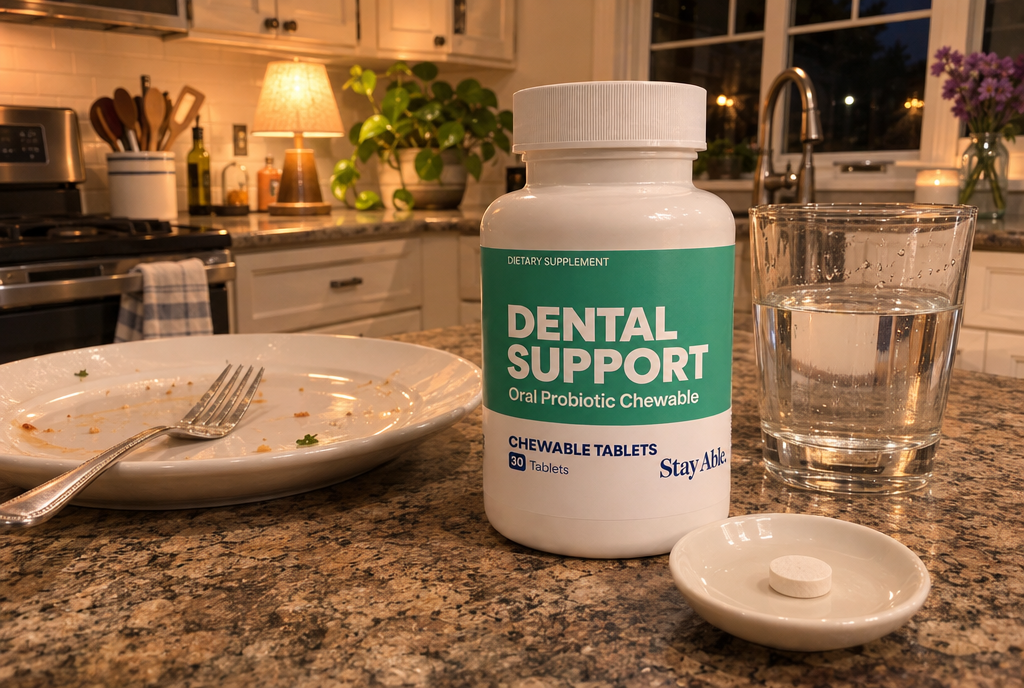
One tablet a day, after a meal. You chew it instead of swallowing it, so it goes to work in your mouth, where the trouble is.
The three strains are for the peacekeeping job. And the xylitol is the opposite of my mints: the troublemakers can't feed on it the way they feed on sugar.
The label says it supports oral health and a healthy balance of bacteria in the mouth. In plain English, it helps keep your breath fresh.
What happened when I tried it
The first night. I chewed one after dinner. No weird taste. My mouth felt clean in a way it usually doesn't by eight in the evening.
The next morning. I noticed what wasn't there. That stale, sticky taste I'd woken up with for years was fainter. I actually stopped and checked.
Day four. I got to lunchtime and realized I hadn't reached for a mint all morning.
Week two. Not perfect. Coffee days were still coffee days. But my breath felt fresher for longer, and my mouth felt cleaner overall.
Week four. My husband leaned in to tell me something at church and I didn't lean back. I only realized afterwards.
Week eight. A bag of peppermints now lasts me a month. And I've stopped doing the math on how close to stand to people.
I still keep the glass of water by the bed. This is a chewable, not a new set of salivary glands.
But my next checkup is in March, and for the first time in years I'm not dreading it.
I'm not the only one

"My hygienist has been on me about my gums for years. I’ve been taking this for two months and she said they looked a little less irritated last visit. Could be the brushing too, but I’m not stopping."

"One capsule after breakfast. No weird taste or anything. My mouth just feels cleaner longer through the day. Simple enough that I don’t forget."

"I hate the dentist. Figured I’d try something at home. Gums don’t bleed as much when I floss now. That’s enough for me to keep taking it."
What I'd want to know
Should I stop my blood pressure pill?
No. Never without your doctor. The pill is doing its job.
Why didn't my doctor mention this?
Mine is a good doctor. But the appointment is fifteen minutes and it's about my blood pressure. Mouths belong to the dentist, and pills belong to the doctor. This falls between the two chairs.
Is it a dry mouth treatment?
No. It doesn't make saliva. It helps with the bacteria job. If your mouth is very dry, tell your doctor or dentist.
Isn't it just an expensive mint?
A mint covers the smell for twenty minutes and feeds the bacteria. This has three named probiotic strains, and it is sweetened with xylitol, which they can't feed on the same way.
How long before I notice anything?
I noticed a difference the first morning. It kept building over the first few weeks.
Won't my coffee wash it away?
I wondered that too. I take mine after dinner, once the coffee and the snacking are done for the day.
Will it upset my stomach?
It hasn't upset mine. Large amounts of xylitol can cause gas or loose stools in some people.
Is it a subscription?
No. You buy it once. You order again only if you want to.
I have a dog.
Keep the bottle where the dog can't get it. Xylitol is harmful to dogs.
What it costs, next to what it's up against
A crown can run into four figures. Original Medicare doesn't cover routine dental work. Not cleanings, not crowns, not dentures.
I was spending about twenty dollars a month on mints and pharmacy sprays that covered things up.
Dental Support is made in the USA, rated 4.9 by customers and trusted by 4,000+. One bottle is a 30-day supply for $37.99.
The better deal is Buy 2, Get 1 Free, so you get three bottles. It's $75.98 instead of $113.97. That saves $37.99 and works out to under 85 cents a day.
You buy it once. Nobody bills you again. There's nothing to cancel, so there's nobody to chase.

Every order has a 100-day money-back guarantee. If it's not for you, return it within 100 days of delivery for a full refund of the purchase price.
I had made up my mind inside two weeks. You get a hundred days.
Two ways this goes
One. You close this page. The pill keeps doing its job on your blood pressure, and its other job on your mouth. The mints. The 2 a.m. water. The dentist finding something. Again.
Two. You keep the pill, and you give your mouth some help with the work your saliva isn't doing. One chewable after dinner. A hundred days to decide.
If you were my sister, I know which one I'd nag you into.
P.S. Tonight, find the leaflet that came with your pill and read the side-effect list. If the words "dry mouth" are on it, you'll know this was written for you.
P.P.S. My granddaughter climbed into my lap last Sunday to tell me a secret. I leaned right in.
Sources: oral microbiome review, NIH PubMed Central; NIDCR Human Oral Microbiome Database; halitosis review, NIH PubMed Central; Delta Dental; Healthline; probiotics and breath odor meta-analysis, BMJ Open 2022; chlorhexidine mouthwash study, Scientific Reports 2020; Dry Mouth and Older Adults, NIDCR.
These statements have not been evaluated by the Food and Drug Administration. This product is not intended to diagnose, treat, cure, or prevent any disease. A supplement isn't a substitute for brushing, flossing or your dentist's advice. Individual experiences vary. Dramatization: Susan Miller is a composite character, and her story is a dramatization.